
How Saudi Vision 2030 Became a Fly Ash Story
Saudi Arabia consumed 13.1 million metric tons of cement in the second quarter of 2025, up 21% year-on-year. The country is on track for approximately 78 million MT of annual cement demand by 2030 — driven by NEOM ($5…
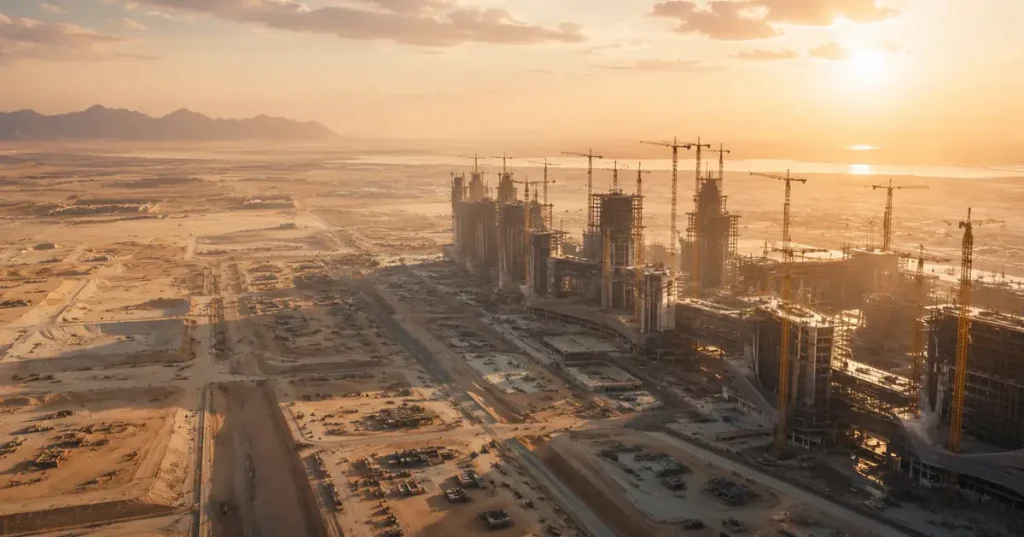
Saudi Arabia consumed 13.1 million metric tons of cement in the second quarter of 2025, up 21% year-on-year. The country is on track for approximately 78 million MT of annual cement demand by 2030 — driven by NEOM ($500 billion), the Red Sea Project, Qiddiya, Diriyah Gate, and a 600,000-home housing programme. Cement at that scale needs supplementary cementitious materials. Fly ash is the largest of those. This article explains why Vision 2030 has become a structural fly ash demand story, what the Class C / Class F distinction means for your sourcing decision, and how Au Club moves up to 1,000,000 MT per year of bulk fly ash into the Gulf.
What is driving Saudi cement demand to 78 million tonnes a year
The Vision 2030 build-out is concrete-intensive at a scale not seen elsewhere in the world. The headline projects:
- NEOM ($500bn). The Line (a linear city), Oxagon (industrial port city), Trojena (mountain resort), Sindalah (luxury island).
- The Red Sea Project. 50 hotels, 8,000 hotel rooms, 1,300 residential properties across 22 islands.
- Qiddiya. Entertainment city near Riyadh: theme parks, motorsport, water parks, residential.
- Diriyah Gate. Heritage-adjacent mixed-use development west of Riyadh.
- Roshn. State-backed residential developer building approximately 600,000 housing units by 2030.
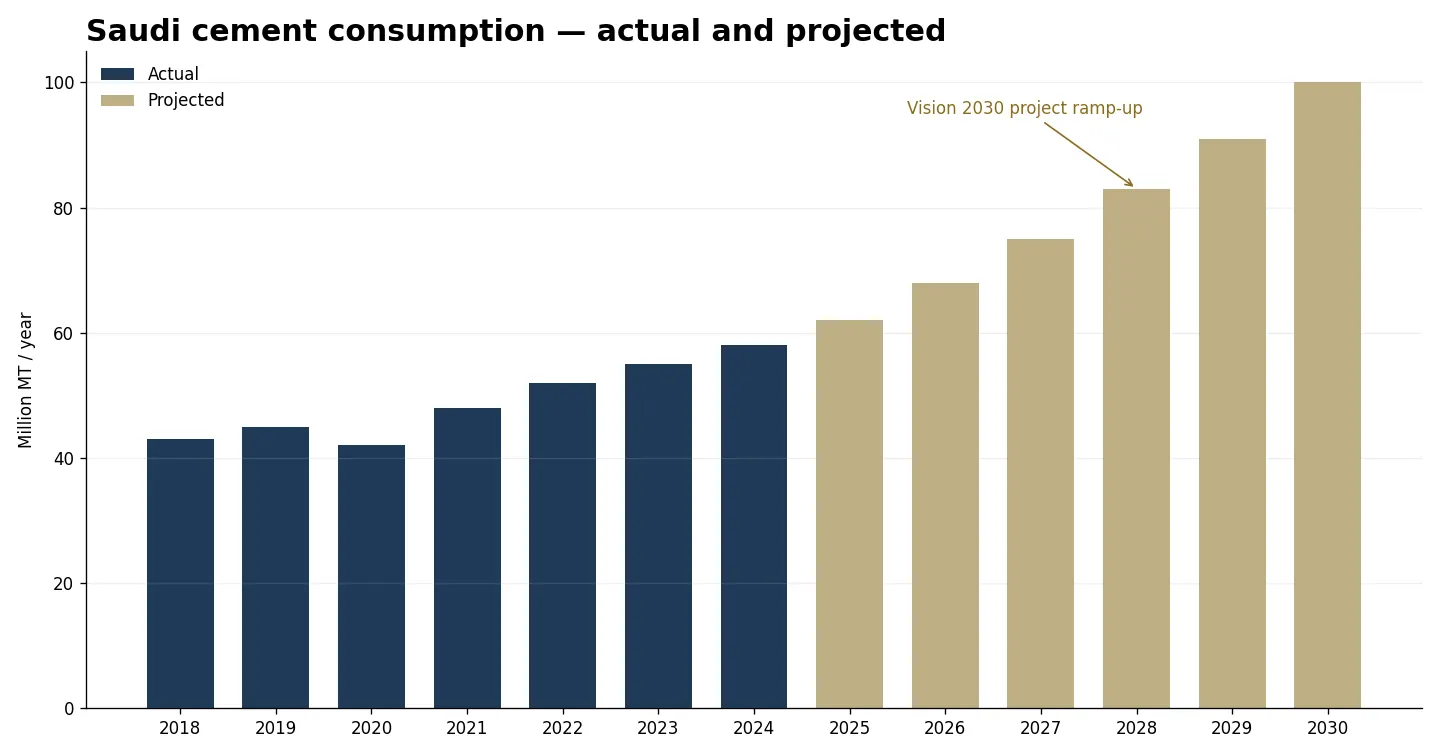
Saudi cement output in 2024 reached approximately 55 million MT. Industry consensus projects 78 million MT by 2030. Q2 2025 sales of 13.1 million MT — annualised, that is about 52 million MT — confirm the trajectory is on plan or modestly above.
A cement-intensive economy that grows from 55 to 78 million MT in five years is not cyclical. It is structural. Cement producers, concrete suppliers, and supplementary cementitious material (SCM) traders are positioning for a multi-decade demand profile.
Why fly ash specifically
Fly ash is a coal-combustion by-product. Pulverised coal burned in power plant boilers leaves a fine glassy residue that, when mixed with portland cement and water, develops cementitious properties. Two practical reasons producers blend fly ash into concrete:
- Cost. Fly ash typically costs less than portland cement. Substituting 15-30% of cement with fly ash reduces concrete cost per cubic metre.
- Carbon. Each ton of portland cement embodies approximately 0.8 ton of CO₂ from calcination and fuel use. Fly ash has zero embodied carbon in the cement substitution role — it would otherwise be landfilled. NEOM and other Vision 2030 projects increasingly specify low-carbon concrete.
In January 2025 the NovusCrete Consortium — Public Investment Fund, NEOM, and other partners — was formed to develop sustainable concrete solutions specifically for giga-projects. Low-carbon concrete with significant SCM content is the working specification.
Beyond NEOM, the wider Saudi cement industry is pulled toward SCM use by carbon-pricing pressure (KSA is exploring an emissions trading scheme) and by international supply chain customers (LEED, BREEAM, and EDGE certifications all reward low-carbon concrete).
Class C vs Class F — the specification distinction
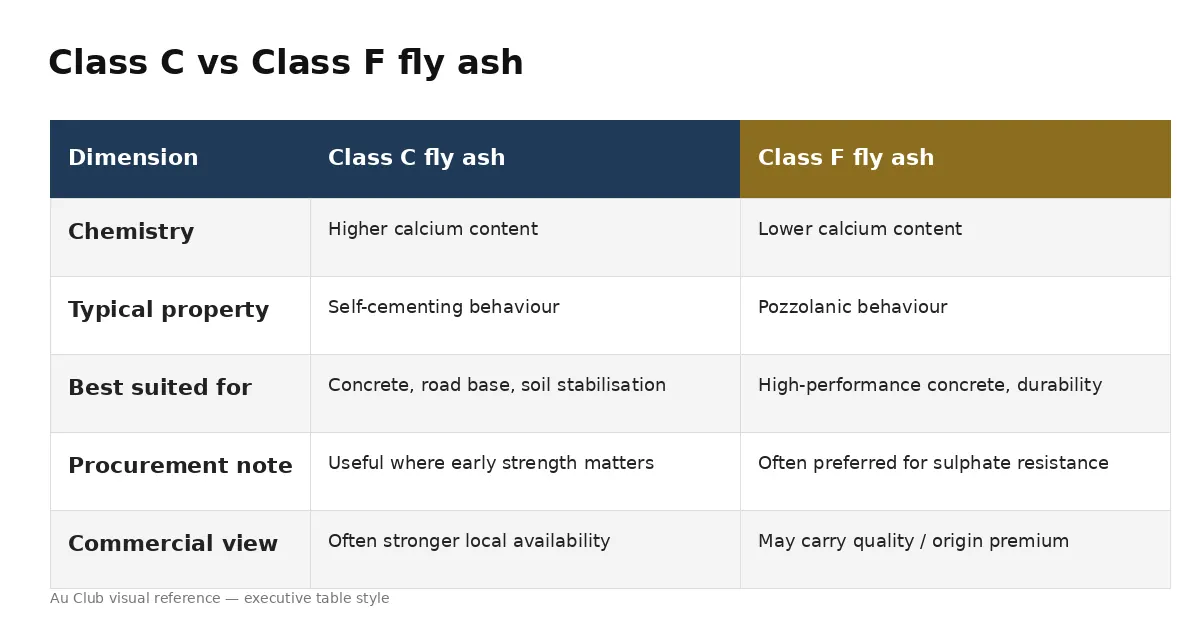
Fly ash sold globally is classified primarily under ASTM C618. Two grades dominate:
Property | Class C | Class F |
Source coal | Sub-bituminous, lignite | Anthracite, bituminous |
SiO₂ + Al₂O₃ + Fe₂O₃ (sum) | ≥ 50% | ≥ 70% |
CaO content | Higher (typically 15-35%) | Lower (typically <10%) |
Self-cementing | Yes (some) | No |
Typical applications | Standard concrete | High-performance concrete, sulfate-resistant |
Loss on ignition (LOI) | ≤ 6% | ≤ 6% |
Class C has higher calcium content. It has some self-cementing properties and can be used at higher replacement ratios in some applications. It is the workhorse for general-purpose concrete.
Class F is the high-performance specification. Its higher silica/alumina/iron content provides better long-term strength, lower permeability, and better resistance to sulfate attack and alkali-silica reaction. It is the specification for marine concrete (Red Sea Project), high-strength applications, and tunnel-lining concrete (NEOM has extensive tunnelling).
Most NEOM, Red Sea Project, and Qiddiya specifications call for Class F. Roshn housing typically uses Class C. A trader supplying the full Vision 2030 portfolio needs reliable origins for both.
The four working origins
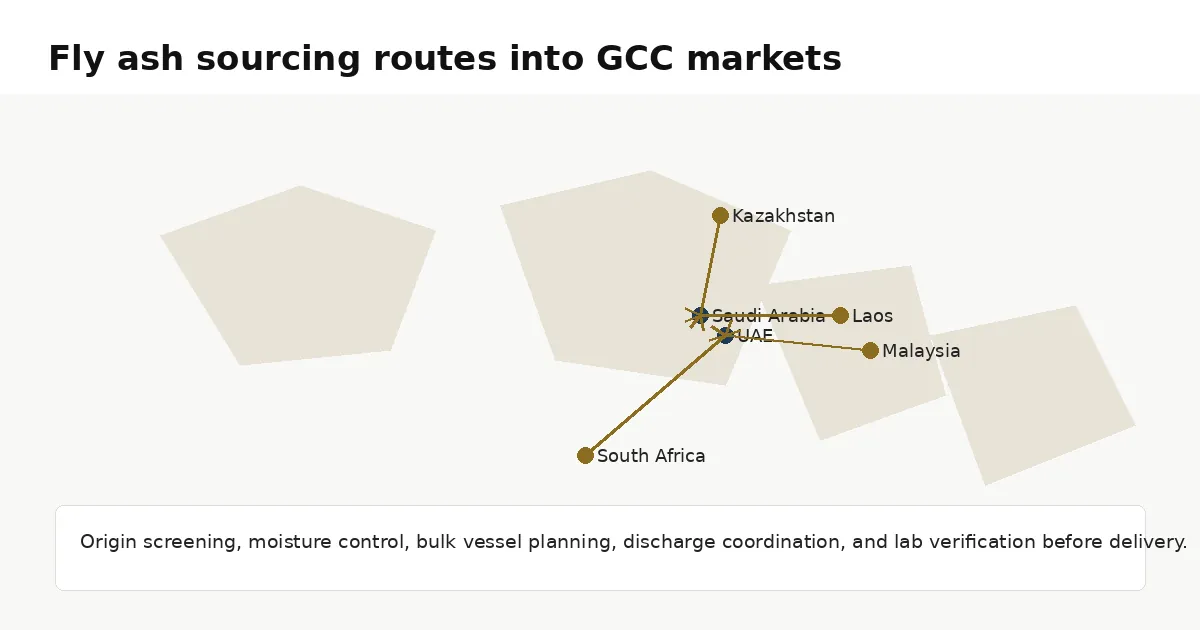
Au Club sources bulk fly ash from four primary origins. Each has its profile:
Laos
Class C and Class F available. Several Lao coal-fired power stations produce export-grade fly ash. Logistics: trucked to Vientiane or Pakse, river barge to Vietnam ports (Hai Phong, Vung Tau) for ocean shipment. Vessel sizing typically Handysize. Moisture spec is the key control point.
Malaysia
Class C predominant. Tanjung Bin and Manjung power stations are the largest sources. FOB Port Klang or Tanjung Pelepas. Vessel sizing Handysize to Supramax. Reliable supply chain. Most accessible quality control.
Kazakhstan
Class F predominant. Ekibastuz and Pavlodar coal complexes generate large fly ash volumes. Land transport via rail to Caspian ports (Aktau) or to Black Sea ports (via Russia, with sanction-related complications). For Gulf delivery, the routing is typically rail to Iranian transit ports — which complicates US-buyer documentation. Most Au Club Kazakh ash goes to Gulf and Mediterranean buyers who do not have US-nexus issues.
South Africa
Class F predominant. Eskom power stations (Lethabo, Matla, Kendal, Majuba) produce significant export volumes. FOB Richards Bay or Durban. Vessel sizing Supramax to Panamax. Established quality control. Au Club’s largest single-origin volume for Gulf delivery.
Origin | Class | Typical FOB port | Vessel size | Moisture spec | Lead time to Jebel Ali |
Laos | Class C / F | Hai Phong, Vung Tau | Handysize | <12% | 25-35 days |
Malaysia | Class C | Port Klang | Handysize-Supramax | <10% | 20-25 days |
Kazakhstan | Class F | Aktau, Bandar Abbas | Handysize | <10% | 30-40 days |
South Africa | Class F | Richards Bay, Durban | Supramax-Panamax | <8% | 20-25 days |
Logistics reality — what changes the price-per-MT delivered
Three practical issues that affect landed cost:
Moisture. Fly ash is hygroscopic. A 12% moisture cargo behaves and handles differently than an 8% moisture cargo. Cement producers specify maximum moisture (usually 8-10%). Above-spec moisture means rejection or steep penalties. Vessels carrying fly ash need closed cargo holds with adequate ventilation.
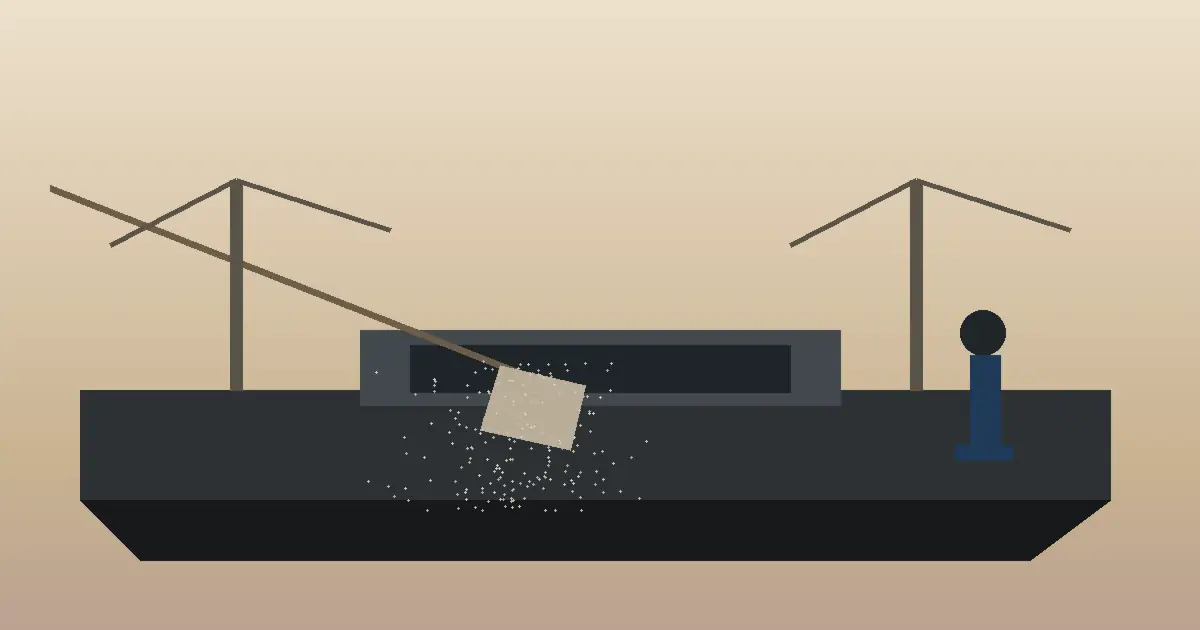
Vessel handling. Bulk fly ash is loaded by conveyor and discharged either by pneumatic suction or by grab. Pneumatic discharge is cleaner and faster but requires specific vessel and port equipment. Many Gulf cement plant discharge facilities prefer pneumatic. The wrong vessel adds discharge cost and time.
Port storage. Jebel Ali, Jeddah, and King Abdullah Port have bulk handling capacity but limited dedicated fly ash storage. Cement plants typically run silo-to-vessel chartering — meaning vessel scheduling matters more than spot inventory. A reliable supply partner manages the silo-fill cycle, not just the shipment.
How an Au Club fly ash contract is structured
Standard contract terms for a precast or RMC producer in the Gulf:
- Volume. Annual offtake commitment, with monthly schedule. Up to 1,000,000 MT/year supported across multiple origins.
- Specification. ASTM C618 Class C or F. Specific limits on LOI (≤6%), moisture (≤10% at loading, ≤8% on arrival if specified), residue on 45-micron sieve (≤34%).
- Inspection. SGS or Intertek at loading port and discharge port. Loading certificate includes COA, certificate of origin, moisture certificate.
- Price formula. Most contracts use a CFR Jebel Ali / CFR Jeddah base price, with freight component floating against Baltic Supramax or Handysize index. Some buyers prefer fixed CFR for budget certainty.
- Payment. LC at sight, or 30/60/90 day deferred LC. TT against pre-shipment documents for established buyers.
- Force majeure. Includes adverse weather at loading, port closure, and origin-country export licence issues.
Au Club’s read on 2025-2030 fly ash demand
Three working assumptions:
- Saudi cement demand reaches 70-80 million MT annually by 2030. The trajectory is consistent across forecaster sources. Vision 2030 is not slowing.
- SCM content in giga-project concrete specifications averages 25-35%. Higher in marine and high-strength applications. Lower in routine residential.
- Class F fly ash is the binding supply constraint. South African and Kazakh origins will be sold forward through 2030 within the next 12-18 months.
For cement producers and ready-mix suppliers: lock 2026-2028 supply now. Spot pricing in 2027-2028 will reflect the demand surge. Multi-year contracts at today’s price levels are the strategic move.
FAQs
Is fly ash production declining as coal-fired power is phased out?
Globally, yes — slowly. But coal capacity in Laos, Indonesia, Malaysia, Vietnam, Kazakhstan, and South Africa is not declining at the pace of OECD coal. Working supply for the next 10-15 years is well-established.
What is the difference between Class C and Class F fly ash?
Class C has higher calcium content and some self-cementing properties. Class F has higher silica/alumina/iron content and better high-performance characteristics. Most NEOM and Red Sea Project specifications call for Class F.
How much fly ash can replace cement in a mix?
Typical replacement ratios run 15-30%. Some high-performance and mass concrete applications use 40-50%. The maximum is determined by structural performance requirements, curing time, and ambient conditions.
Where does Au Club source fly ash?
Laos, Malaysia, Kazakhstan, and South Africa. Class C and Class F. Up to 1,000,000 MT/year aggregated across origins. FOB/CFR/CIF terms. SGS or Intertek inspection.
About Au Club
Au Club supplies bulk fly ash (Class C and Class F) up to 1,000,000 MT/year from Laos, Malaysia, Kazakhstan, and South Africa. FOB, CFR, and CIF terms. SGS or Intertek pre-shipment inspection. We supply ready-mix concrete suppliers, precast producers, and cement plants across the Gulf. Contact our trading desk to discuss your 2026-2030 requirement.