Blog

  • VLSFO vs HSFO + Scrubber: A 2026 Total-Cost-of-Ownership Decision

    VLSFO vs HSFO + Scrubber: A 2026 Total-Cost-of-Ownership Decision

    Five years after IMO 2020, the scrubber decision is no longer about whether the technology works. It is about whether the HSFO-to-VLSFO price spread is wide enough to amortise the capital cost before the next regulatory step changes the maths again. With MEPC 83 approving a carbon-pricing framework that takes effect on 1 March 2027, the answer for a vessel built around 2020-2021 has shifted from “obvious yes” to “depends on age, trade lane, and how aggressively you discount future carbon costs.” Here is the framework Au Club’s customers are using to make the 2026 decision.

    Market Snapshot
    0.50%
    IMO global sulphur cap
    1 Mar 2027
    Net-Zero Framework effective
    5 yrs
    Since IMO 2020 came into force
    $2–4M
    Scrubber retrofit capex range

    What changed since IMO 2020 took effect

    On 1 January 2020 the IMO’s 0.50% global sulphur cap entered force. Operators had three compliance options:

    1. Burn VLSFO (very low sulphur fuel oil) at 0.50% sulphur, or MGO/MDO
    2. Install a scrubber (Exhaust Gas Cleaning System, EGCS) and continue burning HSFO at 3.5% sulphur
    3. Switch to LNG, methanol, or another alternative fuel

    Roughly 25% of the world fleet by tonnage installed scrubbers — disproportionately concentrated in container, tanker, and bulker segments where bunker is a high share of operating cost. Most of the remainder run on VLSFO.

    The scrubber spread (the HSFO-to-VLSFO price differential) drove the economics. In early 2020 the spread averaged $250-300 per MT. With a typical scrubber capital cost of $4-8 million depending on vessel size, payback periods were one-to-three years for a modern Suezmax or VLCC.

    Then the spread compressed.

    The scrubber spread in 2020-2025

    HSFO–VLSFO spread at Fujairah and Singapore, monthly averages

    Period

    Fujairah (/MT)

    Q1 2020

    $290

    $310

    Q1 2021

    $90

    $105

    Q1 2022

    $145

    $160

    Q1 2023

    $130

    $145

    Q1 2024

    $110

    $125

    Q1 2025

    $95

    $115

    The compression was driven by two structural forces. Refineries adjusted their crude slate and product mix to produce more VLSFO. HSFO demand fell as part of the fleet converted permanently to VLSFO. The spread settled into a $80-130/MT range that has held for about three years.

    At a $100/MT spread, a 200,000-MT-per-year bunker consumer saves $20 million per year by running HSFO + scrubber. That is still a meaningful number for a fleet operator. But at a $250/MT spread, the same operator was saving $50 million. The economics moved from “compelling” to “good.”

    What the TCO model actually compares

    A five-year total-cost-of-ownership comparison for a Suezmax tanker (modeled here as an illustrative working example, not specific operator economics):

    Assumptions: – Vessel: Suezmax, 158,000 DWT – Annual bunker consumption: 14,000 MT – VLSFO price assumption: $580/MT – HSFO price assumption: $480/MT (spread $100/MT) – Scrubber capex (open-loop): $4 million, fully amortised over 5 years – Scrubber sludge disposal, NaOH (closed-loop only), and maintenance: $80,000/year per scrubber – MEPC 83 carbon-pricing impact phased in from March 2027 (so 2 years out of 5)

    Five-year cumulative cost (USD millions)

    Component

    VLSFO

    HSFO + open-loop scrubber

    HSFO + closed-loop scrubber

    Bunker

    $40.6

    $33.6

    $33.6

    Scrubber capex

    $0

    $4.0

    $5.5

    Scrubber opex

    $0

    $0.4

    $1.2

    MEPC 83 carbon (2027-2029, estimated)

    $1.8

    $2.6

    $2.6

    Sludge + waste handling

    $0

    $0.2

    $0.6

    Total

    $42.4

    $40.8

    $43.5

    At a $100/MT spread, an open-loop scrubber breaks even or modestly outperforms VLSFO over five years on this profile. A closed-loop scrubber does not — the additional opex (sodium hydroxide for neutralisation, sludge disposal) offsets the bunker saving.

    The number that matters is the spread. At $130/MT, open-loop wins comfortably. At $80/MT, it loses. Lock yourself into a regulatory environment that further raises HSFO’s emission cost (the MEPC 83 carbon factor) and the model tightens against scrubbers.

    Operational realities the TCO model doesn’t capture
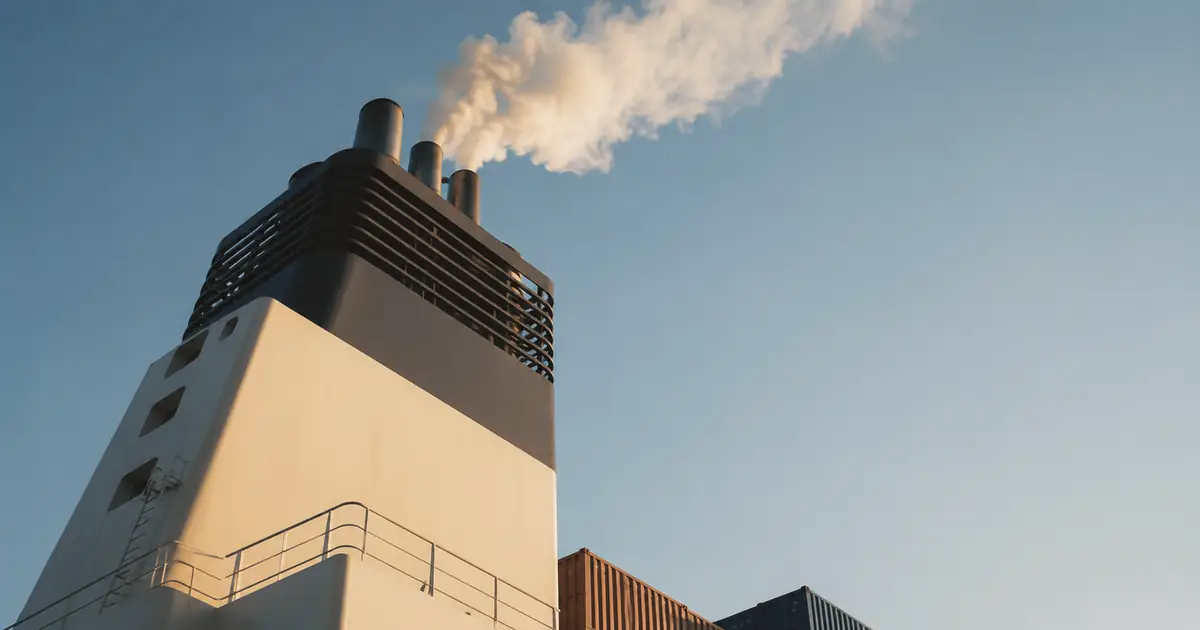
    Close-up of scrubber funnel installation on vessel stack

    Three considerations that matter and are hard to quantify:

    Open-loop discharge restrictions. Singapore prohibits open-loop scrubber discharge inside port limits. China’s coastal Emission Control Areas (Bohai, Yangtze River Delta, Pearl River Delta) restrict open-loop operation. The EU is debating tighter rules under FuelEU Maritime and revised port-state controls. Open-loop scrubbers are progressively losing operational windows. A vessel that spends 30% of its time in restricted waters loses 30% of the scrubber benefit on those legs.

    Closed-loop opex. Closed-loop scrubbers do not discharge to sea, but they consume sodium hydroxide (caustic soda) and generate sludge that must be disposed of. NaOH consumption runs $50-150,000/year per vessel depending on operating profile. Sludge disposal at major ports varies; some ports charge $200-500/m³.

    Resale value. A scrubber-fitted vessel commands a premium in the second-hand market when the spread is wide and a penalty when the spread is narrow. Predicting this five years out is genuinely difficult.

    Carbon-pricing exposure. MEPC 83 prices Remedial Units at up to $380 per ton CO₂e above the base target by 2035. HSFO has a higher carbon factor than VLSFO (3.114 vs 3.151 — actually marginally lower per MT of fuel, because VLSFO has more carbon per MT). The well-to-wake intensity matters more than tank-to-wake under the IMO framework. Run the calculations with your bunker consumption and the framework’s intensity tables.

    Decision tree for an owner or operator
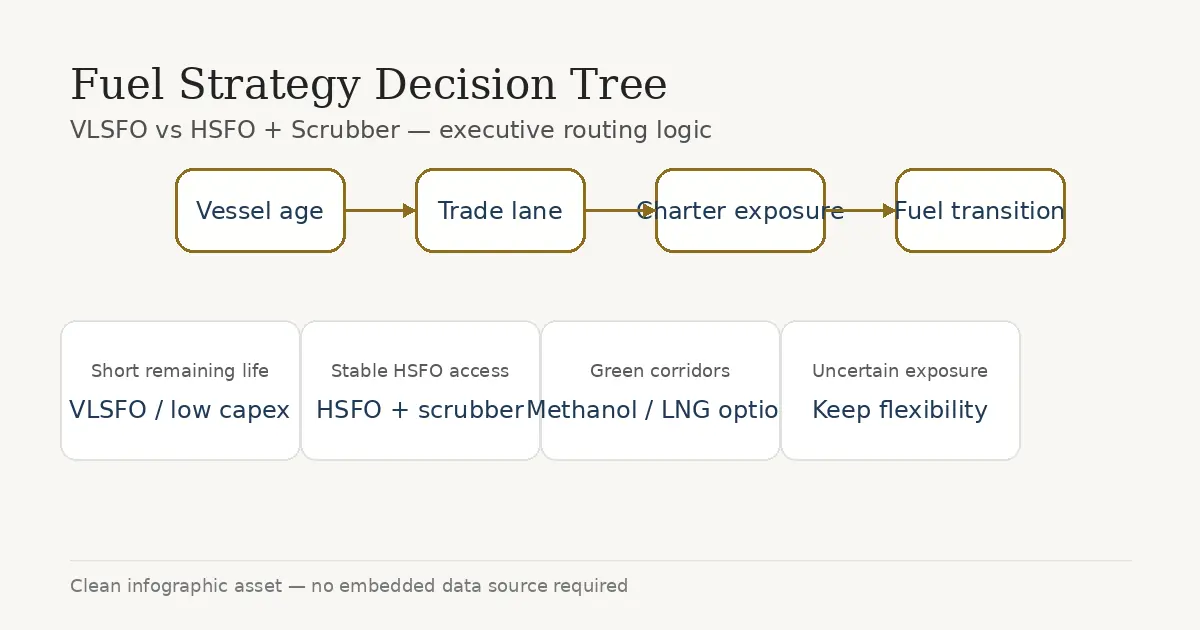
    Decision tree for fuel strategy by vessel age, trade lane, charter exposure

    Practical questions Au Club’s customers run through:

    1. Vessel age. If your vessel is under five years old and has fifteen years of trading life ahead, the capex amortisation works. If she has ten or fewer years left, payback windows are tight.
    2. Trade lane scrubber-friendliness. What share of your trading time is in open ocean vs in scrubber-restricted ports / ECAs? Open ocean tramping favours scrubbers. Asian intra-region container service does not.
    3. Charter market exposure. Are you trading on time charter (where the charterer pays bunkers) or on the spot market (where bunker cost is yours)? Spot market exposure makes the scrubber argument harder because spreads are unpredictable.
    4. Capital cost of capital. A high WACC penalises capex-heavy options. An owner with cheap debt sees scrubbers more favorably than one without.
    5. Future regulatory exposure. Lower-carbon fuels (LNG, methanol, biofuel) will further compress the scrubber economics over time. If you expect to convert to LNG within 7-10 years, do not install a scrubber now.

    What we are telling fleet owners

    Three working assumptions Au Club uses with customers in early 2025:

    1. Do not retrofit a scrubber to an existing VLSFO-burning vessel under 15 years old unless you have very specific circumstances. The capex payback period at current spreads is tight against further regulatory cost on HSFO.
    2. If you already have a scrubber, keep running it. Operating cost is meaningful but the capex is sunk. The five-year economics still work at $100/MT spread for most asset classes.
    3. For new-builds, evaluate LNG, methanol, and dual-fuel capability seriously. The 2027-2030 regulatory environment favours alternative fuels.

    For mid-sized operators without inside views on refinery margins, the simplest rule is: lock VLSFO supply with a multi-year contract, monitor the scrubber spread monthly, and re-run the TCO model annually.

    FAQs

    What is the current HSFO-VLSFO spread at Fujairah?

    As of Q1 2025, the spread is averaging around $95/MT. Contact our bunker desk for spot quotes.

    Should I install a scrubber on a new-build vessel?

    For most asset classes in 2025, no — the economics no longer support a 3-5 year payback at current spreads, and forward-looking carbon pricing further compresses the case. Evaluate LNG or methanol dual-fuel instead.

    Are open-loop scrubbers banned?

    Not globally. Singapore prohibits open-loop discharge inside port limits. China’s coastal ECAs restrict open-loop operation. The EU is reviewing rules. UAE waters currently allow open-loop discharge.

    What does MEPC 83 do to my fuel cost?

    The carbon-pricing framework enters force on 1 March 2027 and can add up to $380 per ton CO₂e by 2035 for fuel emissions above the base target. For a Suezmax burning VLSFO, that translates to a meaningful per-voyage cost. Au Club’s MEPC 83 article walks through worked examples.

    About Au Club

    Au Club supplies VLSFO (0.5% S) and HSFO (3.5% S) marine fuels at Jebel Ali, Port Khalifa, Fujairah, and Khor Fakkan. Multi-year supply contracts available. ISO 8217:2024 compliant. Contact our bunker desk to discuss your 2025-2026 bunker strategy.
    Sources & further reading

  • China Just Added Tungsten and Molybdenum to Its Export Control List. What Happens Next.

    China Just Added Tungsten and Molybdenum to Its Export Control List. What Happens Next.

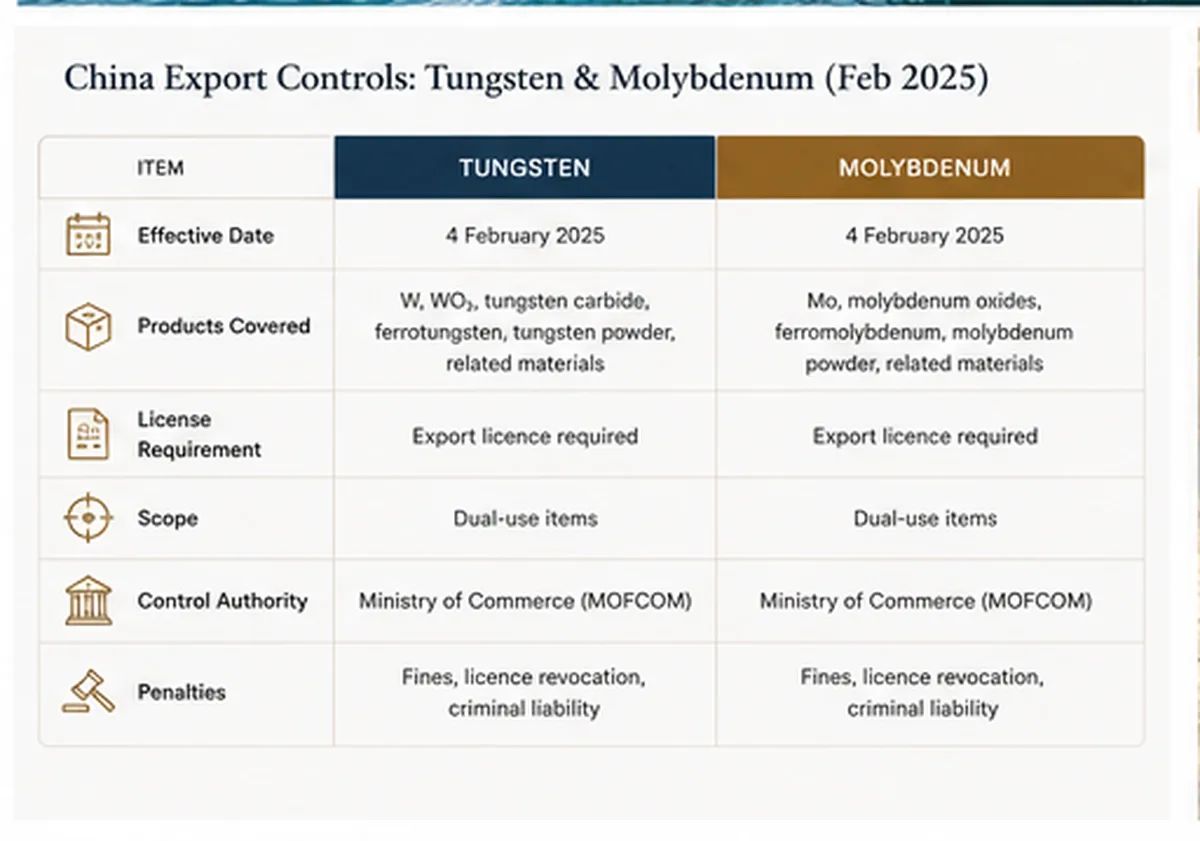
    On 4 February 2025 MOFCOM placed tungsten, tellurium, bismuth, indium and molybdenum on China’s dual-use items export control list. This is the same mechanism that took antimony from $1,400 to $51,000 per metric ton in six months. China supplies roughly 80% of world tungsten and is a dominant molybdenum producer. The price reaction has not yet matched antimony’s, but the mechanism is identical, the precedent is fresh, and the structural picture for Western buyers of APT, ferro-tungsten, and molybdenum oxide is now materially different from what it was a week ago.

    Market Snapshot
    80%
    China share of world tungsten
    5
    Minerals added to control list
    4 Feb 2025
    MOFCOM announcement
    27×
    Antimony precedent (price multiplier)

    What the 4 February notice actually says

    The MOFCOM announcement adds export licensing requirements for tungsten, tellurium, bismuth, molybdenum, and indium and their related items. As with the September 2024 antimony notice:

    • Exporters must apply for individual licences for each shipment
    • End-user and end-use disclosure is required
    • Supporting documentation must accompany each application
    • MOFCOM retains discretion over which licences are approved
    • No country is named in the restriction, but the timing — five days after the US announced 10% tariffs on Chinese imports — is unambiguous

    What the notice does not say is when licences will be approved, what criteria will apply, or whether dual-use civilian applications (cutting tools, stainless steel, lubricants) will be treated differently from defence-adjacent applications (armour-piercing rounds, missile guidance, superalloys).

    The antimony precedent is informative. In the months after the September 2024 antimony licence regime took effect, Chinese exports collapsed by approximately 97%. Few licences have been granted publicly. Sources close to MOFCOM have described the approval rate as deliberate and quiet.

    Why tungsten is the more strategic of the two

    China accounts for approximately 80% of world tungsten mine production. The next largest producers are Vietnam (~5%), Russia (~3%), and a handful of smaller producers in Bolivia, Portugal, Spain, Rwanda, and Austria. The world’s commercially significant tungsten flow has gone through Chinese smelters for thirty years.

    Tungsten is irreplaceable in specific applications. Its melting point (3,422°C) and density (19.3 g/cm³) make it the dominant material for:

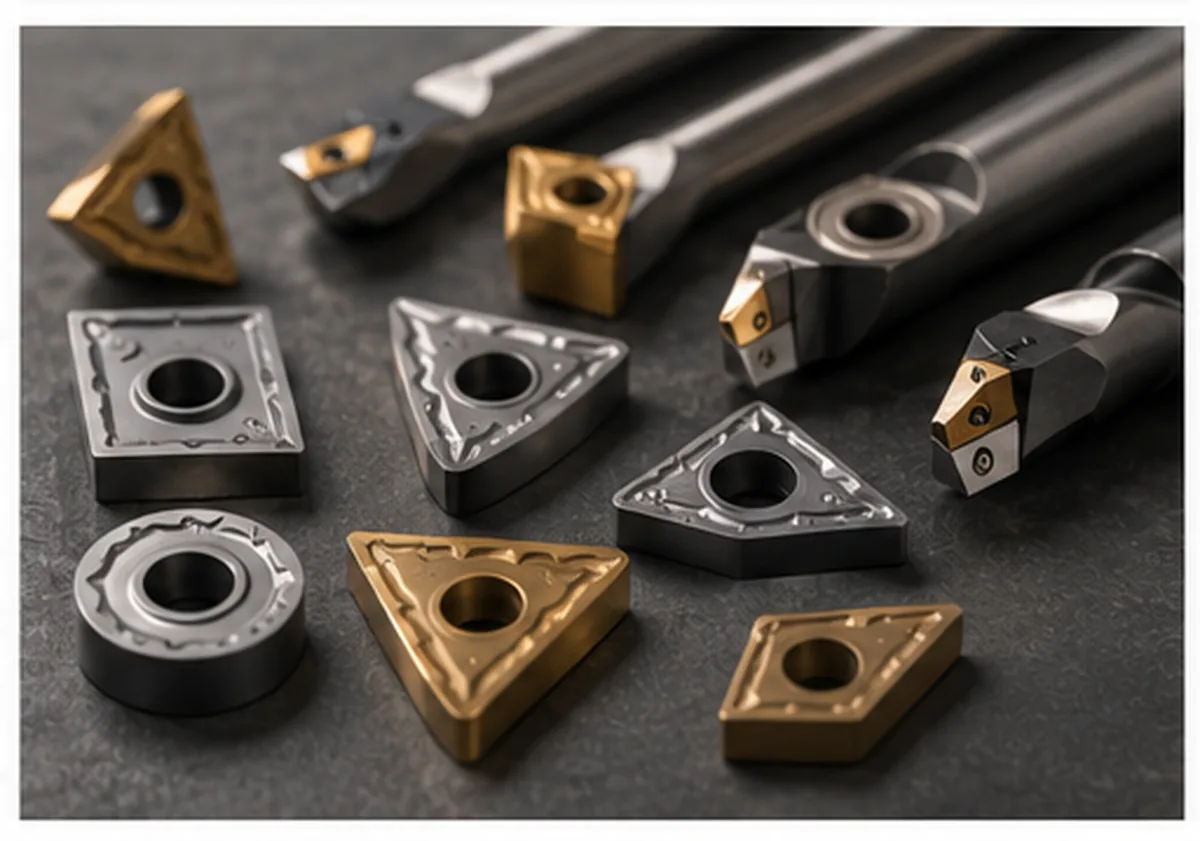
    • Cutting tools — tungsten carbide inserts for machining steel, aluminium, and composites
    • Armour-piercing ammunition — kinetic energy penetrators (replacing depleted uranium in some military applications)
    • Filaments and electrodes — though incandescent applications have declined, TIG welding electrodes and X-ray tube anodes still rely on tungsten
    • Heavy alloys — radiation shielding, gyroscope rotors, counterweights
    • Superalloys — turbine blades, where tungsten is alloyed with nickel and other refractory metals

    The substitution path is poor. Cubic boron nitride substitutes for some cutting-tool applications but at higher cost. Synthetic diamond cuts certain materials better but cannot replace tungsten carbide across the board. There is no substitute at all for tungsten in heavy alloy and ammunition applications.

    The price reaction so far

    Table of China export control timeline and benchmark price moves

    By early June 2025, European ammonium paratungstate (APT) prices were up over 40% from the start of the year. European ferro-tungsten rose 17.6%. The 4 February announcement was the catalyst; the actual licence approvals (or non-approvals) have driven the rolling repricing through Q1 and Q2.

    Tungsten benchmark price moves, Jan–June 2025

    Benchmark

    Jan 2025

    June 2025

    Change

    European APT (USD/MTU WO₃)

    $300

    $425+

    +40%+

    European ferro-tungsten (USD/kg W)

    $34

    $40

    +17.6%

    Chinese 65% concentrate (CNY/MTU)

    110,000

    138,000

    +25%

    A material number of tungsten APT consumers — particularly mid-sized cutting tool manufacturers in Germany, Italy, the US, and Japan — have reported difficulty securing 2026 supply at any forward-priced contract.

    Molybdenum: less concentrated than tungsten, but exposed to the same mechanism

    Molybdenum is structurally different. Roughly half the world’s moly is mined as a primary product (in places like New Mexico, Chile, China). The other half is a by-product of copper porphyry mining at Codelco, Freeport, Antofagasta, and several other large copper producers. That diversification provides some structural cushion against any single producer.

    But China is still the largest moly producer at approximately 40% of global supply. And Chinese moly oxide refining serves global steel mill markets. The MOFCOM licence regime applies to molybdenum and related items — including ferromolybdenum and moly oxide. If approvals slow, the impact lands on Western stainless steel mills, aerospace alloy producers, and lubricant additive manufacturers.

    Through Q2 2025, US moly prices reached $50,265 per MT and Chinese 45% concentrate hit a record 4,600 CNY/ton-unit. The licence regime is one of several drivers (stainless steel demand from grid-scale infrastructure has been strong), but it is a meaningful share of the move.

    Where non-Chinese tungsten and molybdenum lives

    Au Club’s working view of non-Chinese supply for both metals:

    Non-Chinese tungsten

    Country

    Producer / mine

    Indicative output

    Notes

    Vietnam

    Masan High-Tech Materials (Nui Phao)

    ~5,000 t WO₃

    Largest non-China primary tungsten mine

    Thailand

    Multiple small producers

    Variable

    Au Club origin; FOB Laem Chabang

    Malaysia

    Small mines

    Modest

    Au Club origin

    Bolivia

    Several mines

    Modest

    Through Pacific ports

    Portugal

    Beralt Tin and Wolfram

    Modest

    EU buyers

    Spain

    Barruecopardo

    Modest

    EU buyers

    Russia

    OMG, Tyrnyauz

    Significant

    Sanctioned for US/UK direct sale

    Australia

    EQ Resources (Mt Carbine)

    Growing

    Restart phase

    Non-Chinese molybdenum

    Country

    Producer

    Approx share

    Notes

    Chile

    Codelco, Antofagasta

    ~20%

    By-product, scale, captive

    US

    Freeport (Henderson, Climax)

    ~15%

    Primary mines + Cu by-product

    Peru

    Southern Copper, others

    ~10%

    Cu by-product

    Mexico

    Mexicana Cananea

    ~5%

    Cu by-product

    Iran

    NICICO

    ~3%

    Sanctions complications

    Mongolia

    Erdenet

    ~3%

    Cu by-product

    Armenia

    Zangezur

    ~2%

    Cu by-product

    Au Club supplies molybdenum oxide (MoO₃, 63% Mo minimum) with 300 MT/month availability and tungsten concentrate (55–65% WO₃) from Thailand and Malaysia. Tungsten scrap — both carbide and soft scrap — is sourced regionally and is a meaningful partial hedge for cutting-tool buyers facing APT shortages.

    How to position your supply book

    Three actions worth taking now:

    1. Audit your 2025-2026 forward contracts. If your existing supplier is Chinese — directly or via a smelter that aggregates Chinese ore — your contract is exposed to licence non-approval.
    2. Open a relationship with at least one non-Chinese supplier. Even at higher unit cost. The option value of having a working non-China channel exceeds the price premium.
    3. For tungsten carbide buyers, evaluate scrap. Tungsten carbide scrap can be re-processed into APT or used directly in some applications. Scrap pricing has tracked APT closely but with more available volume.

    For very large buyers, multi-year offtake agreements with non-Chinese producers (Masan, Codelco, Freeport, EQ Resources) are now more accessible than they were in 2023 because Western producers are looking for non-China end-market commitments.

    Au Club’s read

    Tungsten and molybdenum are not going to retrace to pre-February 2025 levels in any realistic 2025 scenario. Our working range for European APT through 2025 is $420-520 per MTU WO₃. For US moly, $50,000-$60,000 per MT. The downside scenario — large MOFCOM approval wave — requires a US-China trade agreement that has not been signalled at any working level.

    What we are telling buyers: do not wait for clarity. The clarity, when it comes, will come in the form of further escalation or a long, quiet plateau at higher prices. Build your non-China book now.

    FAQs

    Are tungsten exports from China actually banned?

    No. They are under a licensing regime. The practical effect — based on the antimony precedent and limited approved licences since 4 February 2025 — has been a sharp reduction in Chinese tungsten export flow. Whether this constitutes a de facto embargo depends on MOFCOM’s approval rate over time.

    Where can I source non-Chinese tungsten?

    Vietnam (Masan Nui Phao), Thailand, Malaysia, Bolivia, Portugal, Spain, and (when sanctioned imports clear) Russia. Australia (Mt Carbine) is restarting commercial production. Au Club supplies concentrate from Thailand and Malaysia, plus tungsten scrap.

    Is tungsten carbide scrap a viable substitute for APT?

    For many cutting-tool re-manufacturing applications, yes. Scrap re-processing into APT is established technology. The economics work when APT prices are this elevated. Au Club buys and sells both carbide and soft tungsten scrap.

    Will the price come back down?

    Au Club’s working view is no, not in 2025. A return to early-2024 prices requires a meaningful US-China trade agreement and a clear MOFCOM approval pattern, neither of which has been signalled.

    About Au Club

    Au Club is a Dubai-based commodity trading company specialising in metals, minerals, and marine fuels. We supply tungsten concentrate (55-65% WO₃) from Thailand and Malaysia, tungsten scrap (carbide and soft), and molybdenum oxide (MoO₃ 63% Mo minimum). SGS or Alex Stewart pre-shipment inspection. LC and TT accepted. Contact our trading desk.

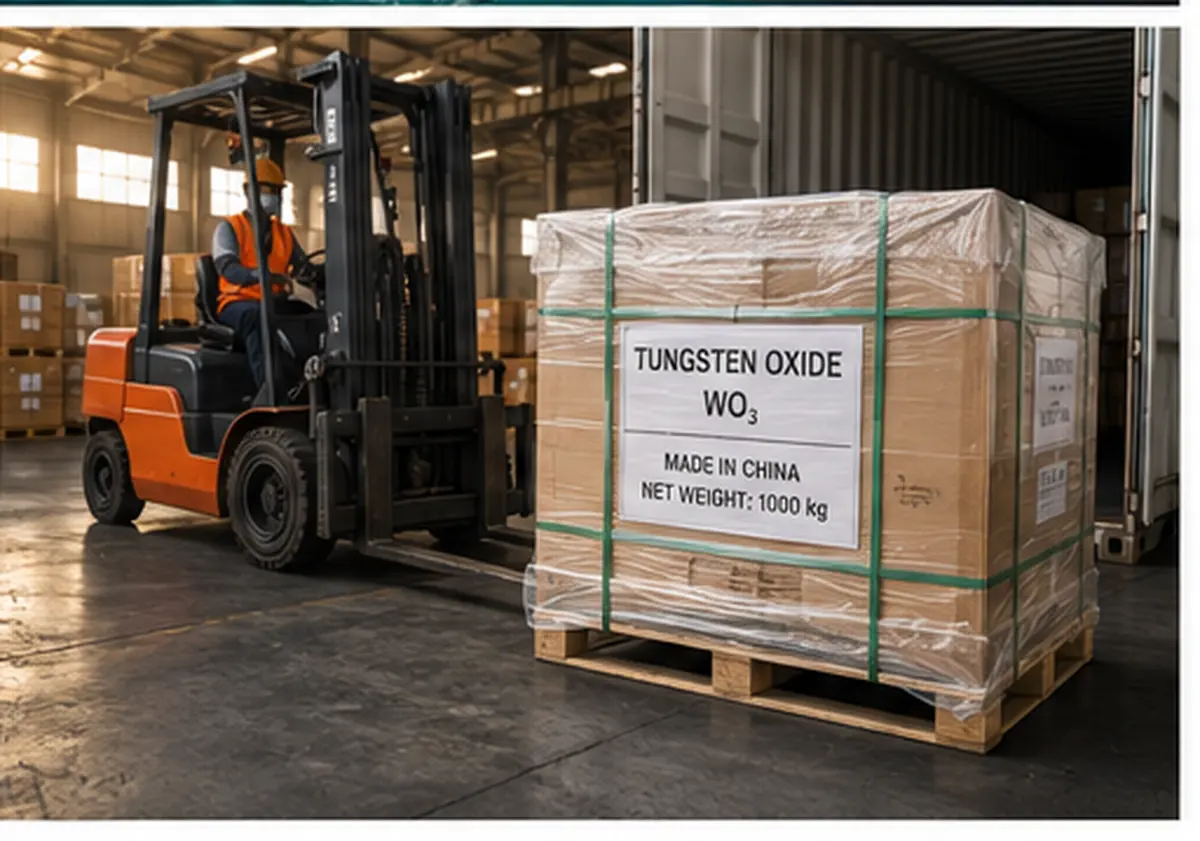
    Tungsten oxide stored in warehouse with quality control inspector

    Sources & further reading

  • Red Sea Rerouting: How the Cape of Good Hope Is Redrawing Bunker Demand

    Red Sea Rerouting: How the Cape of Good Hope Is Redrawing Bunker Demand

    The Cape of Good Hope diversion costs roughly $1 million in extra bunker per Asia-Europe round-trip and adds about ten days at sea. If your fleet was built around a Suez-Bab-el-Mandeb routing — and most container, tanker, and Capesize operators planned that way for thirty years — your 2025 fuel budget is structurally different from your 2022 budget. This article walks through the cost, the new map of bunker demand, and what we are telling charterers about where the demand picture goes from here.

    Market Snapshot
    $1M+
    Extra bunker per Asia-EU round trip
    +10 days
    Added voyage time via Cape
    Nov 2023
    Houthi attacks began
    ~30%
    Suez container traffic drop (2024)

    The disruption in numbers

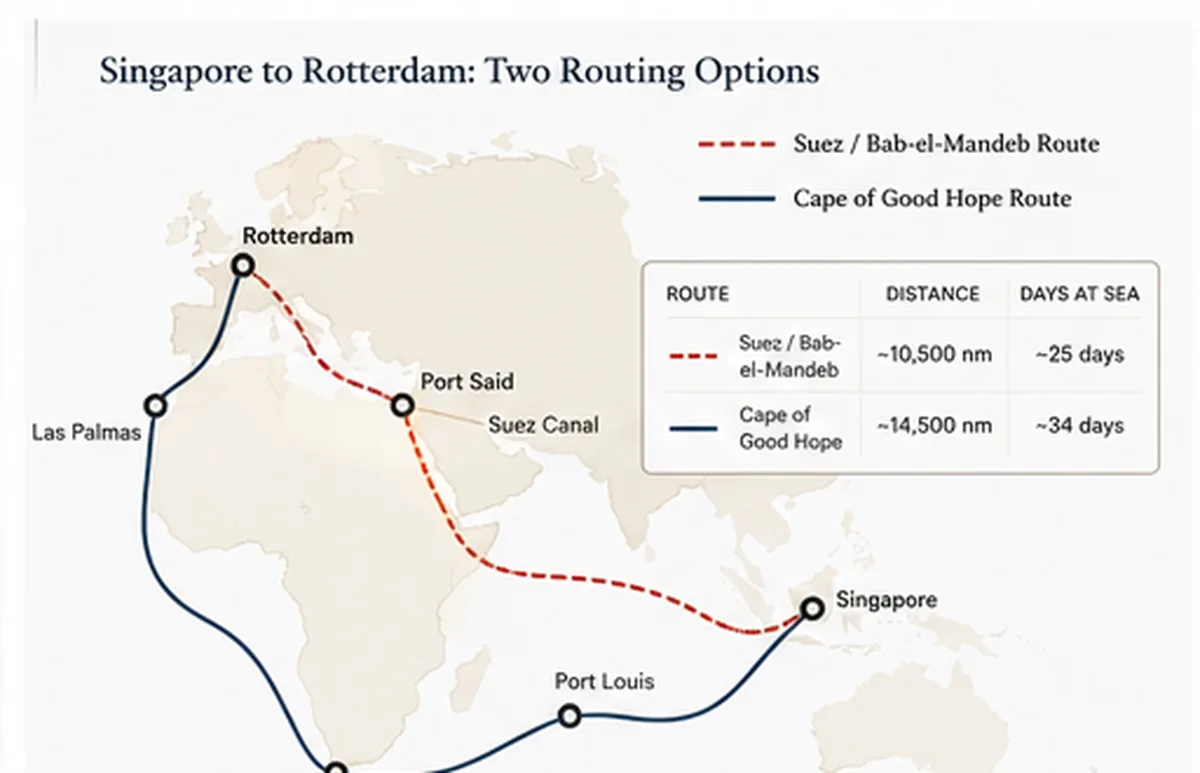
    Map comparing Suez/Bab-el-Mandeb route and Cape of Good Hope route from Singapore to Rotterdam

    Houthi attacks on commercial shipping in and around Bab-el-Mandeb began in November 2023. By October 2024 the US Defense Intelligence Agency had counted over 190 attacks. Container shipping through the Red Sea dropped by approximately 90% between December 2023 and February 2024.

    The major carriers responded by rerouting. Maersk, MSC, CMA CGM, Hapag-Lloyd, Evergreen and ONE moved the bulk of their Asia-Europe and Asia-US East Coast services around the Cape of Good Hope. Tanker operators and dry bulk owners followed for vessel classes where the war-risk premium outweighed the routing cost.

    By late 2024 the Houthis signalled willingness to halt attacks. Marine underwriters did not return to pre-2023 risk pricing. Most major operators kept the Cape routing through January 2025.

    What the diversion costs per voyage

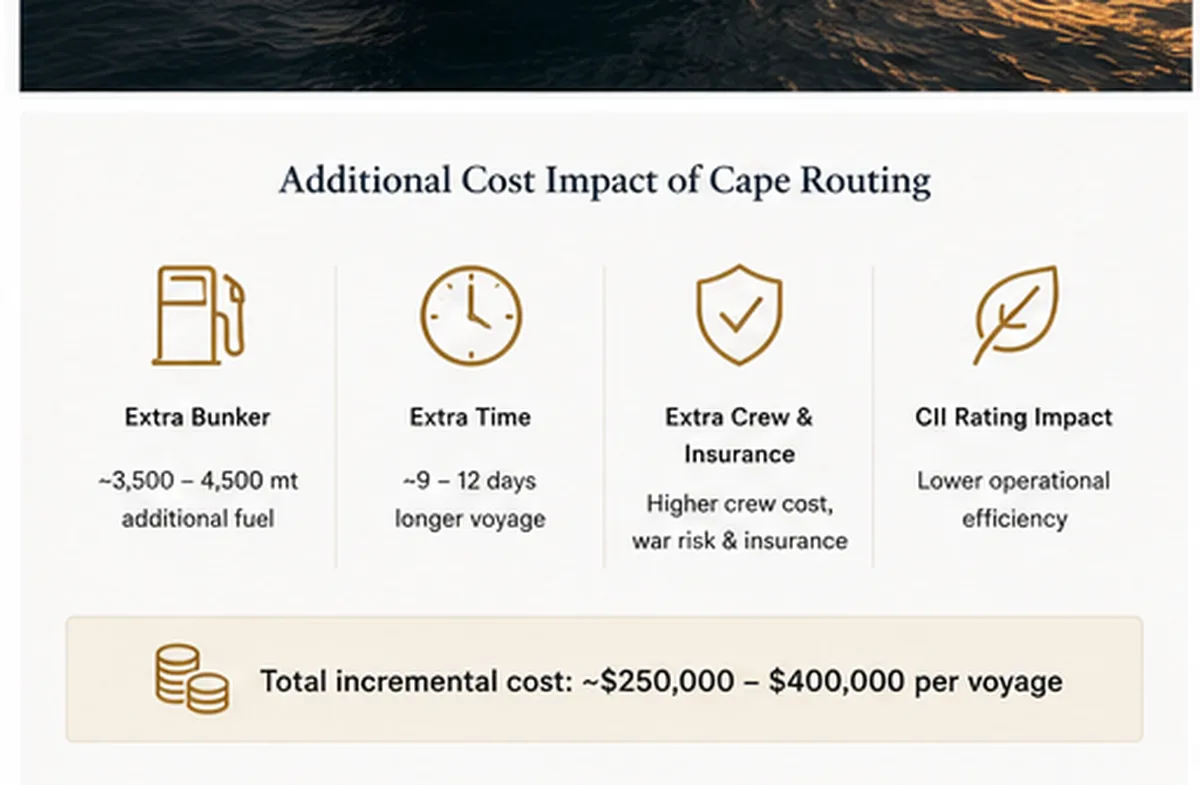
    Infographic of four cost components added by Cape routing: bunker, time, insurance, CII

    The Cape of Good Hope routing adds roughly 3,500 nautical miles each way on a Singapore–Rotterdam round-trip. At commercial steaming speeds, that is about ten extra days. The bunker cost depends on vessel class and consumption.

    Worked example: 14,000-TEU container vessel, 220 MT/day VLSFO consumption at sea speed, $580/MT average bunker price.

    Item

    Suez routing

    Cape routing

    Delta

    One-way distance (nm)

    8,300

    11,800

    +3,500

    Sea days at 18 kts

    19

    27

    +8

    Round-trip bunker (MT)

    8,360

    11,880

    +3,520

    Round-trip bunker cost

    $4.85m

    $6.89m

    +$2.04m

    Plus war-risk premium for Suez route (if used)

    $300-700k

    n/a

    included

    A Suezmax tanker on the same Asia-Europe lane sees a similar order-of-magnitude increase in absolute terms, less in percentage terms. A Capesize bulk carrier on Iron Ore Australia–Europe routes via Cape was already the standard, so for that vessel class the change is smaller.

    For a container line running fifteen weekly strings on Asia-Europe, the cumulative bunker shift is significant — multiple billions of dollars per year of incremental fuel demand globally.

    How global bunker demand has redistributed

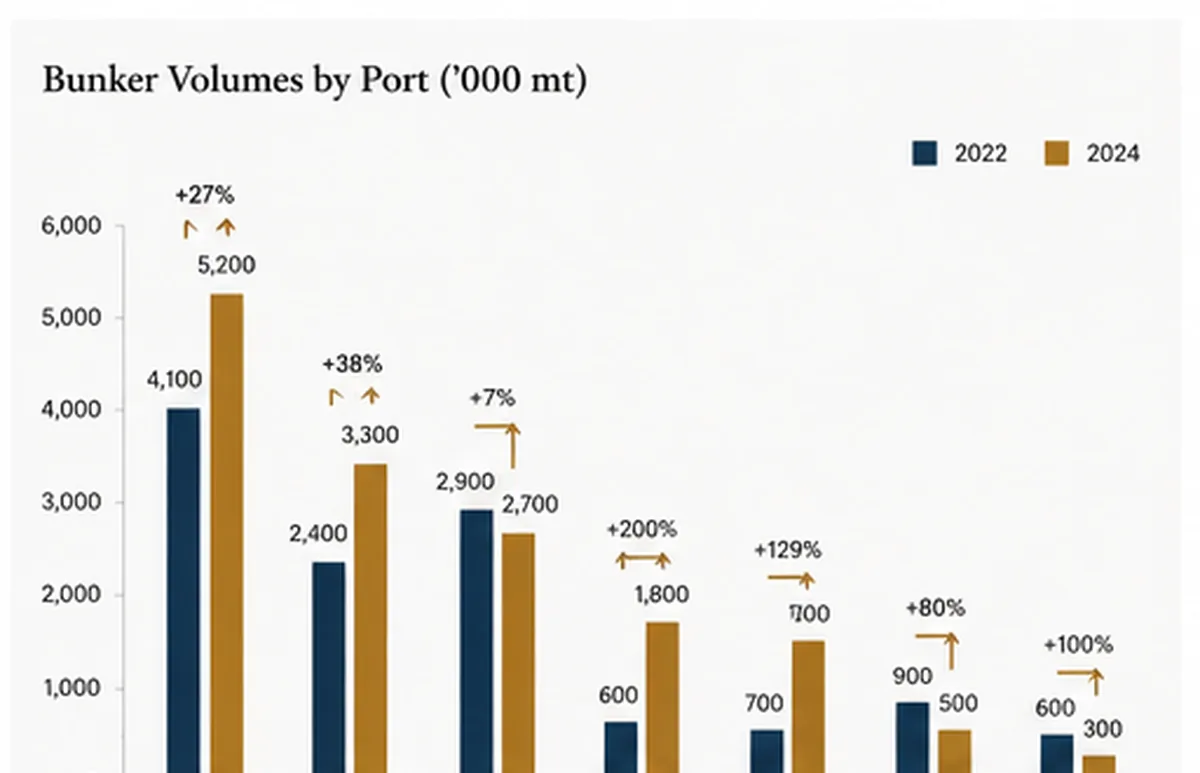
    Bar chart of bunker volumes by port 2022 vs 2024 showing Port Louis and South African ports rising

    The geographic redistribution is what matters for trading desks. The traditional bunker hubs — Singapore, Fujairah, Rotterdam, Algeciras, Las Palmas — have all moved, but in different directions.

    Port

    2022 volume (MT)

    2024 volume (MT)

    Change

    Singapore

    ~50m

    ~54.9m

    Modest rise

    Fujairah

    ~30m

    ~33m

    Steady rise

    Rotterdam

    ~9.5m

    ~10.2m

    Slight rise

    Port Louis (Mauritius)

    ~0.5m

    ~1.0m

    Doubled

    Cape Town

    ~0.6m

    ~0.9m

    +50%

    Durban

    ~0.5m

    ~0.8m

    +60%

    Algoa Bay (anchorage)

    ~0.1m

    ~0.3m

    Tripled

    The South African and Indian Ocean island ports are the standout movers. Vessels rerouting around the Cape need to refuel somewhere on the southern leg. Port Louis in Mauritius has become a meaningful staging port; Algoa Bay anchorage off Port Elizabeth has tripled from a small base.

    For Fujairah, the impact is more subtle. The port did not lose Asia-Europe transit volume — that traffic was always east of the Strait of Hormuz. What it gained was firmer demand from Indian Ocean voyages that previously chose to bunker at Salalah (Oman) or at Aden (no longer viable). Fujairah’s anchorage congestion has increased; barge waits have lengthened in peak weeks.

    What changed between the late 2024 Houthi ceasefire and early 2025

    The Houthi political wing made statements in late 2024 indicating willingness to halt attacks on commercial shipping. The maritime market did not snap back. Three reasons:

    Insurance. War-risk premiums for Bab-el-Mandeb transit climbed through 2024 to multiple percent of hull value for some vessel classes. Underwriters require sustained risk-free passage before re-pricing.

    Schedule reliability. Carriers built their 2025 sailing schedules around Cape routing in mid-2024. Re-routing back to Suez mid-schedule introduces port-omission risk, charter-party conflicts, and customer-service problems. Most carriers committed to the Cape route at least through Q2 2025.

    Underwriter caution. Even if the route reopens, a single attack will close it again. Several major underwriters indicated they wanted six months of unbroken safe passage before reducing war-risk premiums to pre-2023 levels.

    The result is a slow, conditional return — not a switch back.

    How charter parties are repricing risk

    In 2024 charter party clauses had to be rewritten to accommodate the new routing. The most-used updates:

    • BIMCO War Risks Clause for Time Chartering 2013 activated to allow re-routing without breaching the charter
    • Conwartime 2013 for voyage charters, with the Cape route as an explicit alternative
    • Bunker Adjustment Factor (BAF) for liner shipping, repriced to reflect actual Cape-route consumption
    • CII assistance clauses to accept that the longer route worsens the vessel’s Carbon Intensity Indicator rating — and to allocate the cost between owner and charterer

    The CII issue is awkward. The IMO’s Carbon Intensity Indicator measures grams of CO₂ per deadweight-ton-mile. A longer routing means more emissions, but also more distance, so the per-distance metric does not necessarily worsen as much as raw fuel consumption suggests. Different charter forms allocate the rating penalty differently. Pre-2024 CP language does not handle this cleanly; expect to see CII-specific addenda in 2025 fixtures.

    What we are telling charterers

    Three working assumptions Au Club’s desk uses with charterer customers through 2025:

    1. The Cape routing continues for most carriers through Q2 2025 at minimum. Insurance and schedule inertia will outlast the operational risk reduction.
    2. Fujairah bunker premia to Singapore will hold or widen modestly. Indian Ocean rerouting and the Gulf’s stable supply give Fujairah a strategic role in 2025 that 2022 routing planning did not anticipate.
    3. Plan bunker stems with longer lay-cans. Anchorage congestion at Cape Town and Fujairah peaks unpredictably. Build flexibility into the charter party.

    For voyage owners contracted on liner-fed routes, the bunker arithmetic has changed enough that 2022’s optimised stemming plans no longer apply. Re-modelling annual bunker cost with Cape-route assumptions is now a quarterly exercise, not an annual one.

    FAQs

    Are ships still avoiding the Red Sea in January 2025?

    The majority of container shipping on Asia-Europe lanes continues to use the Cape of Good Hope route. Tanker traffic is mixed. Some bulk carriers have returned to the Suez route. Underwriter caution and schedule commitments make a full return unlikely before Q2 2025.

    How much extra fuel does the Cape route use?

    For a 14,000-TEU container vessel on Singapore-Rotterdam round-trip, approximately 3,500 MT extra VLSFO per round-trip, or about $2 million at $580/MT. Suezmax and Capesize equivalents differ.

    Where are ships bunkering on the Cape route?

    The growth ports are Port Louis (Mauritius), Cape Town, Algoa Bay anchorage, and Durban. Singapore, Fujairah, and Rotterdam remain dominant but for different reasons (Singapore Asia-end staging, Fujairah Indian Ocean staging, Rotterdam Europe-end).

    Has Fujairah benefited from the Red Sea crisis?

    Yes, modestly. Indian Ocean routing benefits Fujairah’s strategic position east of Hormuz. Bunker volume rose to approximately 33 million MT in 2024.

    About Au Club

    Au Club supplies VLSFO and HSFO marine fuels at Fujairah, Jebel Ali, Port Khalifa, and Khor Fakkan. ISO 8217:2024 compliant. Multiple physical suppliers per port for competitive price discovery. ISO 14001-aligned procedures. Contact our bunker desk for stem enquiries.

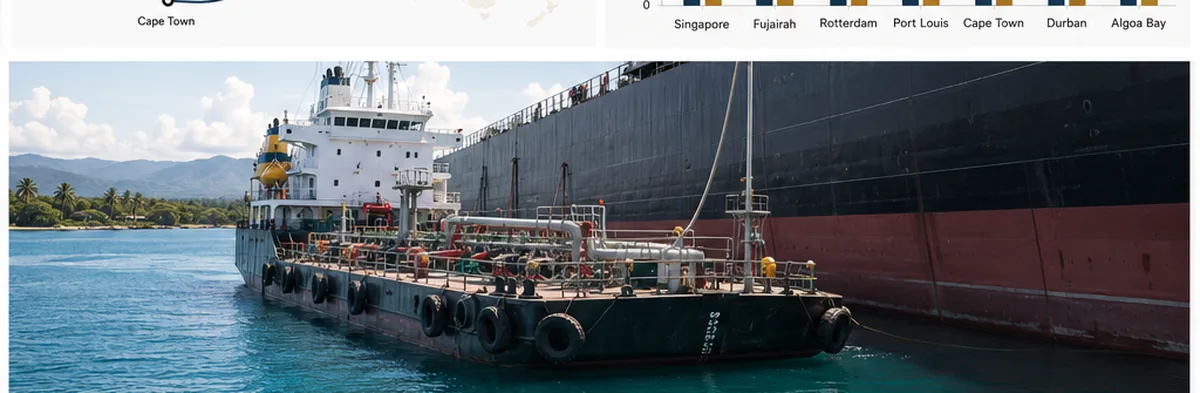
    Bunker barge alongside large vessel at Port Louis anchorage

    Sources & further reading

  • Tin Market Outlook 2024: Supply Tightness, Demand Resilience, Price Support

    Tin Market Outlook 2024: Supply Tightness, Demand Resilience, Price Support

    Market Snapshot
    $31,250
    LME 3M Price (May 17, 2024)
    -3.2%
    Global Supply YoY (2023)
    +2.8%
    Global Demand YoY (2023)
    ~2,000 MT
    Market Deficit (2024E)

    Executive Summary

    The 2024 tin market continues to exhibit structural tightness, driven by constrained supply growth and resilient demand from the electronics sector. We anticipate the LME 3-month tin price to remain supported above $30,000/MT through the year.

    Global Demand Outlook

    Demand for tin is supported by resilient electronics production and the transition to advanced manufacturing. Asia remains the largest consuming region, accounting for over 65% of global refined tin consumption.

    Solder applications continue to dominate end-use demand, representing approximately 47% of total consumption, with growth driven by semiconductor packaging and electric vehicle electronics.

    Supply Landscape

    Supply remains concentrated in a few key regions. Weather disruptions, permitting delays, and resource nationalism continue to weigh on growth.

    Country 2023 Output (MT) Share
    China 68,000 23%
    Indonesia 64,000 22%
    Myanmar 30,000 10%
    Peru 25,000 9%
    Bolivia 15,000 5%

    Price & Market Dynamics

    LME tin has demonstrated remarkable resilience in 2024, trading in a range between $28,500 and $33,000/MT. Inventory levels at LME-registered warehouses have declined steadily, reflecting genuine physical tightness rather than positioning.

    We expect a structural deficit to persist in 2024, underpinned by constrained supply growth and steady industrial demand.— Au Club Research

    Regional Focus

    Africa

    African production, primarily from the DRC and Rwanda, contributes incrementally to global supply. Conflict mineral certification requirements continue to shape sourcing decisions for ITRI-compliant buyers.

    Middle East

    The Middle East serves as a critical trans-shipment and refining hub. Dubai-based traders provide essential price discovery and documentation infrastructure for buyers seeking non-Chinese supply alternatives.

    Asia

    Southeast Asia dominates global production. Thailand and Malaysia have emerged as important secondary processing hubs, offering documented FOB supply outside Chinese export channels.

    What to Watch

    • Indonesian export policy and potential ban extensions on raw concentrate
    • Myanmar production stability and licensing renewals
    • LME inventory trajectory and any backwardation signals
    • EV adoption rates and their cascading impact on solder demand

    Key Takeaways

    The tin market is structurally supported through 2024 and into 2025. Buyers with regular consumption profiles should consider establishing forward supply relationships at current price levels, particularly with non-Chinese origin material to manage geopolitical risk.

  • Jebel Ali, Fujairah, or Khor Fakkan? A Buyer’s Cost Comparison for UAE Bunkering

    Jebel Ali, Fujairah, or Khor Fakkan? A Buyer’s Cost Comparison for UAE Bunkering

    The three UAE bunkering options are not interchangeable. Fujairah is the global benchmark, the third-largest bunker hub in the world, and the default for transit voyages. Jebel Ali is the port-of-call advantage when your vessel is loading or discharging cargo in Dubai. Khor Fakkan has anchorage capacity that has become significant since Red Sea diversions began. Which one to use depends on voyage economics, lay-can flexibility, and what you are paying for in the BDN. This is the working comparison Au Club’s bunker desk uses with charterers.

    Market Snapshot
    3
    UAE bunkering ports compared
    #3
    Fujairah global bunker hub rank
    24–72h
    Spot order lead time
    Platts UAE
    Pricing benchmark

    The three-port picture

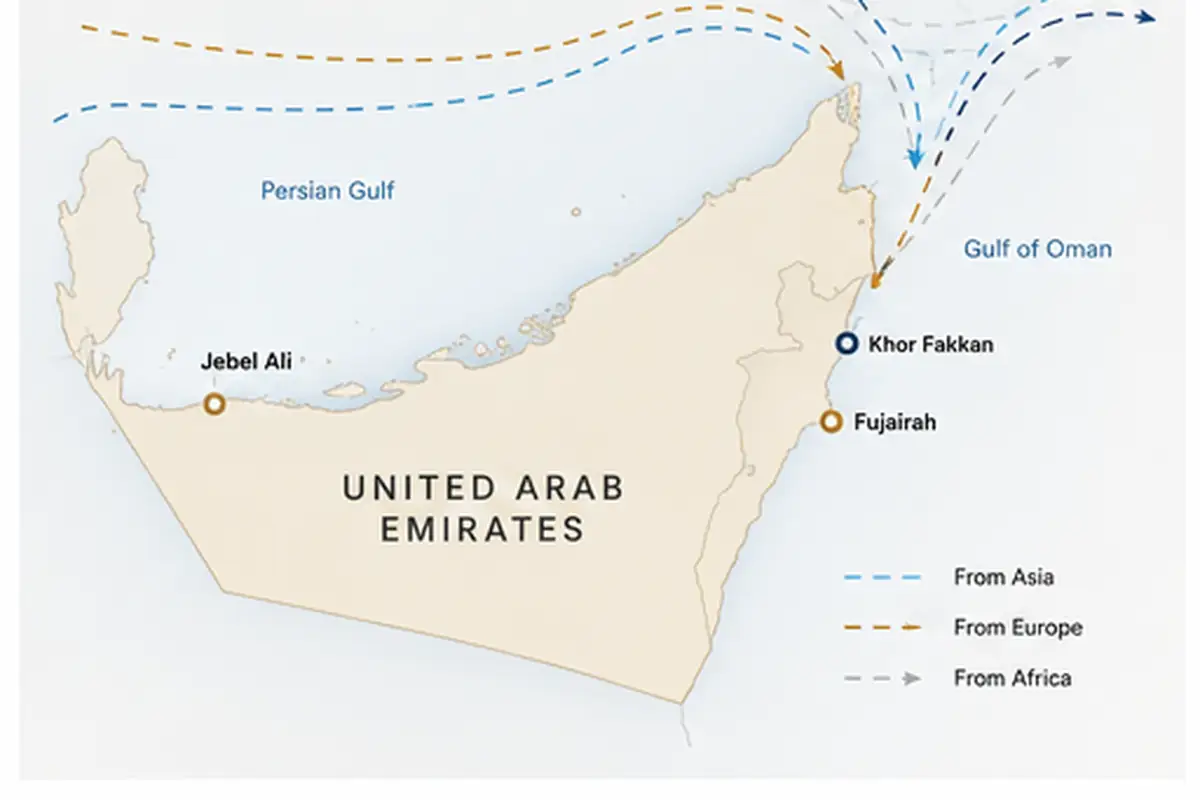
    Map of UAE showing Fujairah, Khor Fakkan, and Jebel Ali bunker ports

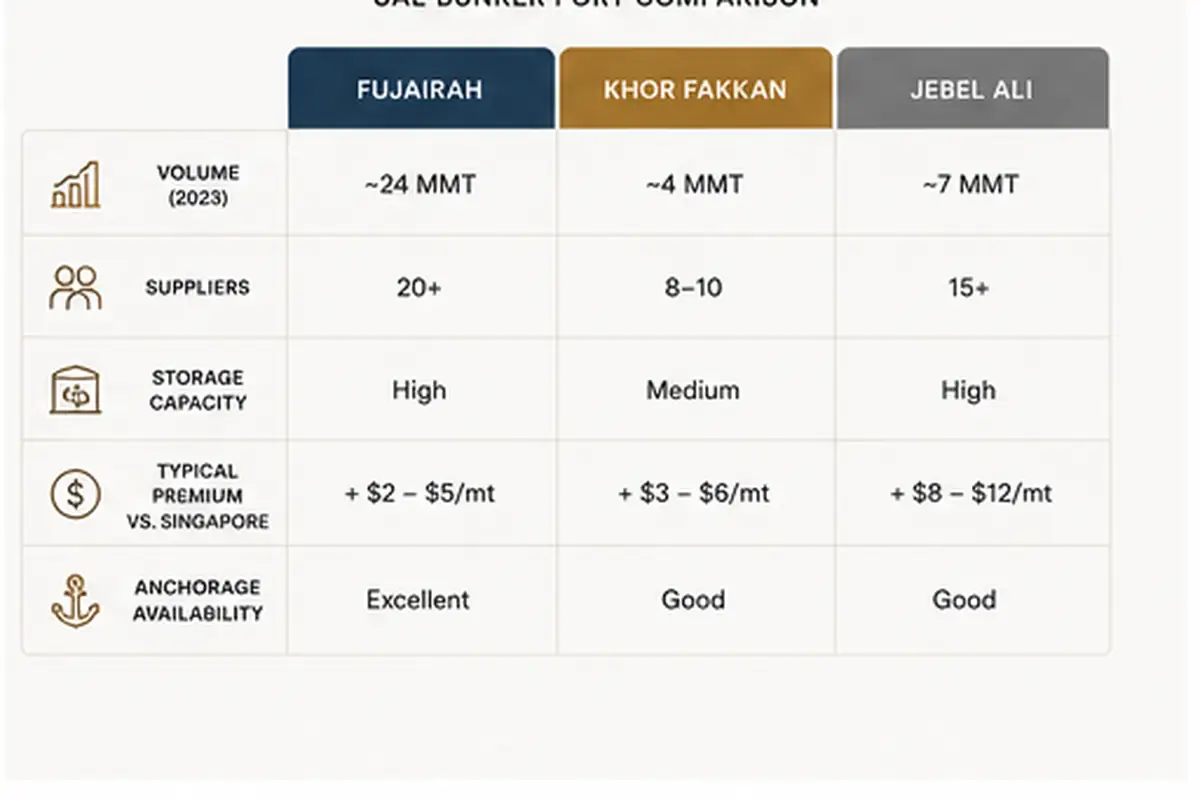
    Three Emirates serve the UAE bunker market. Each has its own physical infrastructure, supplier mix, and trading reputation.

    Port

    2023 bunker volume

    Coast

    Storage operators

    Physical suppliers (approx)

    Notes

    Fujairah

    ~32 million MT

    East (Gulf of Oman)

    Vopak Horizon, Concord, ENOC

    35+

    World #3 bunker hub. Open ocean anchorage.

    Jebel Ali

    ~3 million MT

    West (Persian Gulf)

    ENOC, DP World tank farms

    8-10

    Port-of-call bunkering. Inside the Gulf.

    Khor Fakkan

    ~1 million MT

    East (Gulf of Oman)

    Limited landside storage

    4-6

    Anchorage and container terminal.

    The headline difference is volume. Fujairah moves around ten times the bunker tonnage of Jebel Ali. Its storage capacity, supplier count, and supplier competition make it the price-setter for the region. The Platts FOB UAE / Fujairah marker is what nearly every bunker invoice in the Middle East references, directly or indirectly.

    Why Fujairah is the regional benchmark

    Three structural reasons:

    Geography. Fujairah sits on the Gulf of Oman, outside the Strait of Hormuz. A vessel transiting between Asia and Europe via Suez does not need to enter the Persian Gulf to bunker at Fujairah. That saves up to 36 hours of steaming versus Jebel Ali for a vessel that is otherwise transiting.

    Storage depth. Vopak Horizon Fujairah alone holds approximately 3.5 million m³ of liquid storage. Concord, ENOC, and several other operators bring the total well above 10 million m³. This is what lets the port absorb supply-chain shocks that would dry out a smaller hub.

    Supplier competition. With 35+ physical bunker suppliers, the spread between the highest and lowest offer on any given day is typically $5-15 per MT for VLSFO. That is the cheapest discovery process in the region.

    The Platts FOB UAE VLSFO marker, the Fastmarkets Fujairah VLSFO assessment, and the Ship & Bunker Fujairah index all reference physical deals concluded into the port’s anchorage.

    When Jebel Ali makes sense

    Jebel Ali is the right answer when:

    • Your vessel is loading or discharging cargo at Jebel Ali Port or DP World terminals on the same call. The bunker stop is incremental, not a detour.
    • You need ultra-low sulphur fuels or specific grades that Fujairah’s bid-stack does not show that day.
    • Your charter party requires a UAE west-coast bunker for cargo-specific reasons (some FOB sale contracts specify Jebel Ali load).
    • You want simpler port formalities — DP World’s integrated agency handles the bunker stem alongside cargo operations.

    Pricing at Jebel Ali typically runs $2-8 per MT above Fujairah VLSFO. The premium reflects supplier concentration (fewer competing barges) and tighter storage. For a ship already inside the Gulf, that premium is more than offset by the avoided detour fuel and time.

    Khor Fakkan after the Red Sea diversion

    Khor Fakkan’s role changed in 2024. As Cape of Good Hope diversions pulled Asia-Europe vessels off the Bab-el-Mandeb route, the port’s anchorage became attractive for vessels staging eastbound or westbound voyages without entering Fujairah’s congested approaches.

    Khor Fakkan does not have Fujairah’s storage depth. Bunker barges shuttle product from Fujairah and from ENOC storage. The premium over Fujairah VLSFO runs $3-10 per MT, and the supplier count is small. The advantage is anchorage availability and reduced barge wait when Fujairah is congested.

    For a transit vessel that values certainty of slot over price, Khor Fakkan in 2024-2025 has been the contingency option.

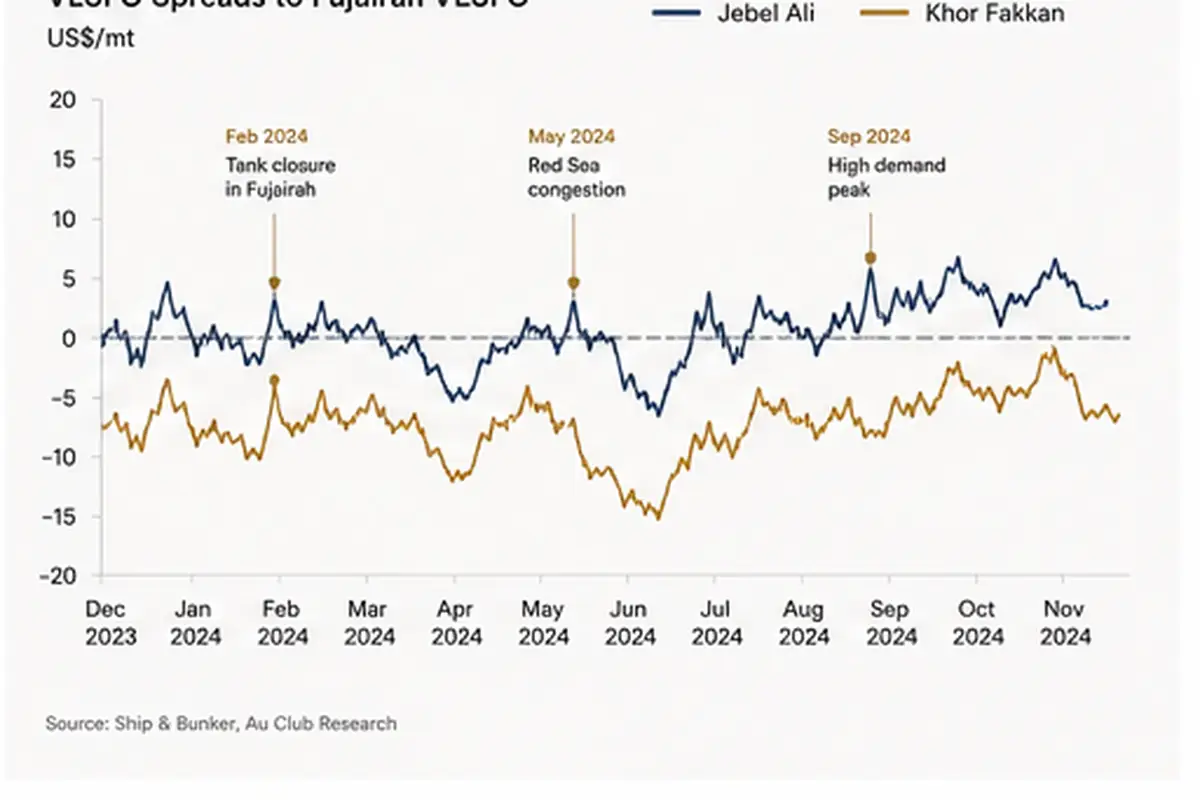
    Price spreads — what the 12-month rolling shows

    12-month VLSFO price spread chart Jebel Ali and Khor Fakkan versus Fujairah

    Twelve-month rolling pattern for the three ports against Fujairah VLSFO as the reference:

    Port pair

    VLSFO spread (USD/MT)

    Typical driver

    Jebel Ali – Fujairah

    +$2 to +$8

    Supplier concentration, barge availability

    Khor Fakkan – Fujairah

    +$3 to +$10

    Re-supply via Fujairah, smaller bid-stack

    Singapore – Fujairah

    +$5 to +$25

    Asia demand premium

    Rotterdam – Fujairah

    -$10 to +$10

    West/East arbitrage

    The Fujairah / Singapore spread is the most-watched. When it is negative (Fujairah more expensive), Gulf bunker demand is pulling barrels east. When it is positive by more than $15/MT, traders are arbing product west into the Middle East. The Au Club desk monitors this spread daily for our voyage chartering customers.

    What to insist on in the BDN

    The Bunker Delivery Note is the document that matters when there is a dispute. Five lines to check on every UAE bunker stem:

    1. ISO 8217:2024 specification compliance — confirms the fuel meets sulphur, viscosity, density, sediment, and stability parameters. Insist on the 2024 revision.
    2. Sulphur content — for VLSFO, ≤0.50% m/m. Sample sealing and chain of custody documented.
    3. Density at 15°C — affects mass-to-volume conversion. Confirm the meter reading and the lab figure.
    4. Sample sealing in the presence of Chief Engineer and supplier representative — four samples (ship retain, supplier, MARPOL, independent). Without this you have no dispute path.
    5. Quantity verification by tank gauging plus volumetric meter — both methods, signed by both parties. The most expensive bunker disputes are quantity disputes.

    The MARPOL sample is the legally significant one. It is the sample tested if the port-state control inspector challenges your sulphur compliance. Keep it sealed for at least twelve months.

    Buyer’s checklist before you stem

    Before you send the bunker requirement to a supplier or to Au Club:

    • Vessel name, IMO, flag, last port, next port
    • Grade required (VLSFO 0.5% S, HSFO 3.5% S, MGO DMA)
    • Quantity (with min/max tolerance, usually ±5%)
    • Lay-can (earliest/latest delivery dates)
    • Payment terms (typical UAE bunker terms: 30 days net from BDN)
    • Discharge port if relevant (affects route economics)
    • Charter party clauses you need the bunker stem to honour (Cl.1 specifications, MARPOL Annex VI compliance)

    The faster the requirement reaches the desk in standard format, the better the price discovery. A nine-line requirement that includes all the above will close in under two hours. An incomplete enquiry will take a day and end with a worse price.

    Au Club’s role

    Au Club supplies VLSFO (0.5% S) and HSFO (3.5% S) at Jebel Ali, Port Khalifa, Fujairah, and Khor Fakkan. We work with multiple physical suppliers at each port, which gives our charterer clients price discovery across the available bid-stack rather than a single supplier’s pricing. ISO 8217:2024 compliant. Full BDN documentation. Sample sealing and laboratory testing through SGS or Intertek where requested.

    To request a quote, send the nine-line requirement to our bunker desk. Response time within two business hours.

    FAQs

    Which UAE port is cheapest for VLSFO?

    Fujairah, in almost every twelve-month window. The supplier count and storage depth produce the tightest bid-stack. Jebel Ali typically runs $2-8/MT above Fujairah; Khor Fakkan $3-10/MT above.

    Can I bunker at Khor Fakkan without staging via Fujairah?

    Yes, but the supplier count is small. For predictable supply, Fujairah is the safer choice unless anchorage congestion at Fujairah is the binding constraint.

    What is the difference between Port Khalifa and Fujairah for bunkering?

    Port Khalifa (Abu Dhabi) is a smaller bunker market focused on local supply. Fujairah is the regional benchmark. Au Club covers both.

    Are scrubber vessels welcome at all three ports?

    Open-loop scrubber discharge is permitted in UAE waters (unlike Singapore and parts of EU). Closed-loop and hybrid systems are unrestricted. All three ports stem HSFO.

    About Au Club

    Au Club is a Dubai-based commodity trader supplying marine fuel at Jebel Ali, Port Khalifa, Fujairah, and Khor Fakkan. VLSFO 0.5%, HSFO 3.5%, MGO DMA. ISO 8217:2024 compliant. Request a bunker quote at our website.

    Side-by-side comparison of UAE bunker ports — volume, suppliers, premium

    Sources & further reading

  • Antimony Shock: Why Prices Just 27x’d in Sixty Days

    Antimony Shock: Why Prices Just 27x’d in Sixty Days

    Antimony went from $1,400 per metric ton in July 2024 to $38,000 per metric ton by mid-September. That is not a price move. That is a market structure change. If you buy antimony oxide for flame retardants, antimony trioxide for PVC stabilisers, or antimony concentrate for lead-acid batteries, the contract you signed in May 2024 no longer means what it meant when you signed it. This is what happened, why the price will not snap back, and how to rebuild your antimony supply book around it.

    Market Snapshot
    $1,400 → $48,000
    Antimony price Jul → Nov 2024
    27×
    60-day price multiplier
    -97%
    Chinese exports YoY (Sep 2024)
    48%
    China share of world mine output

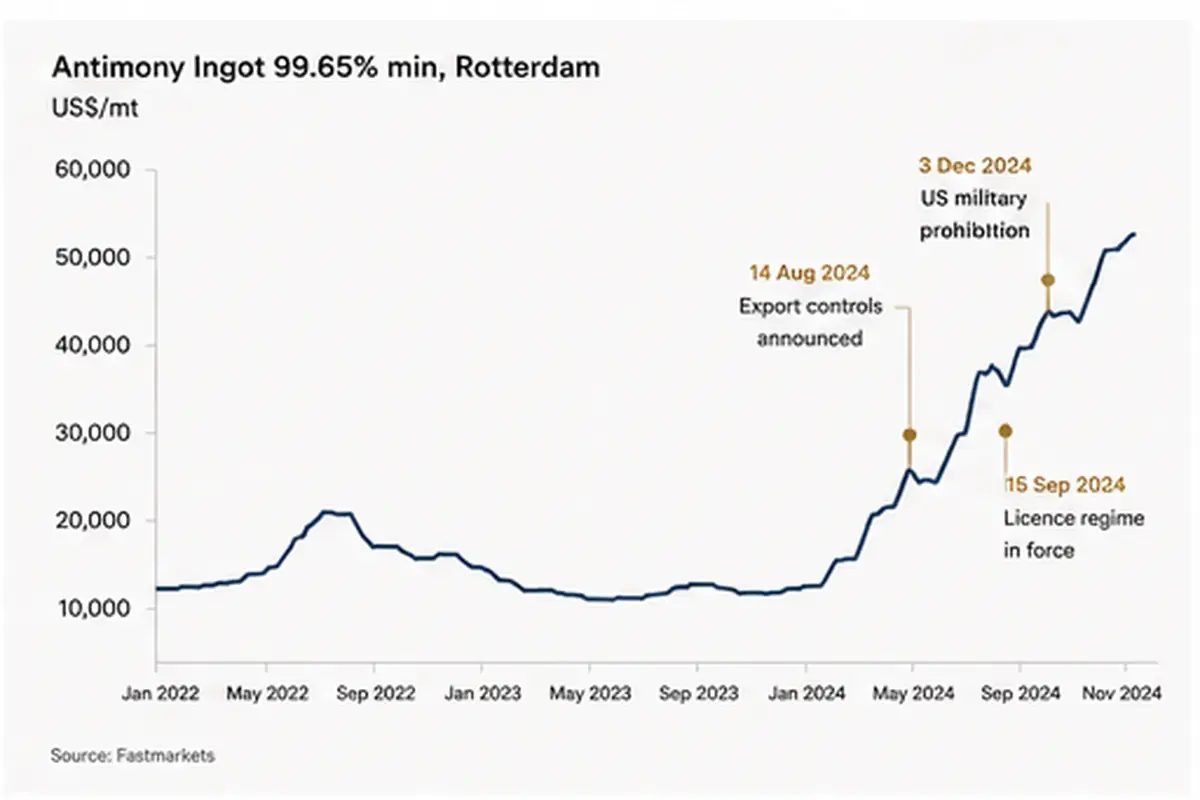
    What changed on 14 August and 15 September 2024

    Antimony price chart July to November 2024 showing rise from $1,400 to $48,000 per MT

    On 14 August 2024, China’s Ministry of Commerce (MOFCOM) and the General Administration of Customs published Announcement No. 33: antimony and a range of antimony compounds were added to China’s dual-use items export control list. The licence regime took effect on 15 September 2024. From that date, any Chinese exporter of antimony or antimony products had to obtain individual export licences from MOFCOM, with end-user disclosure, end-use justification, and supporting documentation.

    On 3 December 2024, MOFCOM tightened the screw a second time: a full prohibition on exports of antimony products to United States military end-users, or for military end-uses.

    The mechanism reads like a licensing regime. The practical effect has been a near-total halt in Chinese antimony export flow. Chinese antimony exports for September 2024 fell by approximately 97% year-on-year. October and November showed marginal recovery. MOFCOM has approved very few applications publicly. The Chinese authorities have not articulated criteria.

    Why this is a structural problem, not a price spike

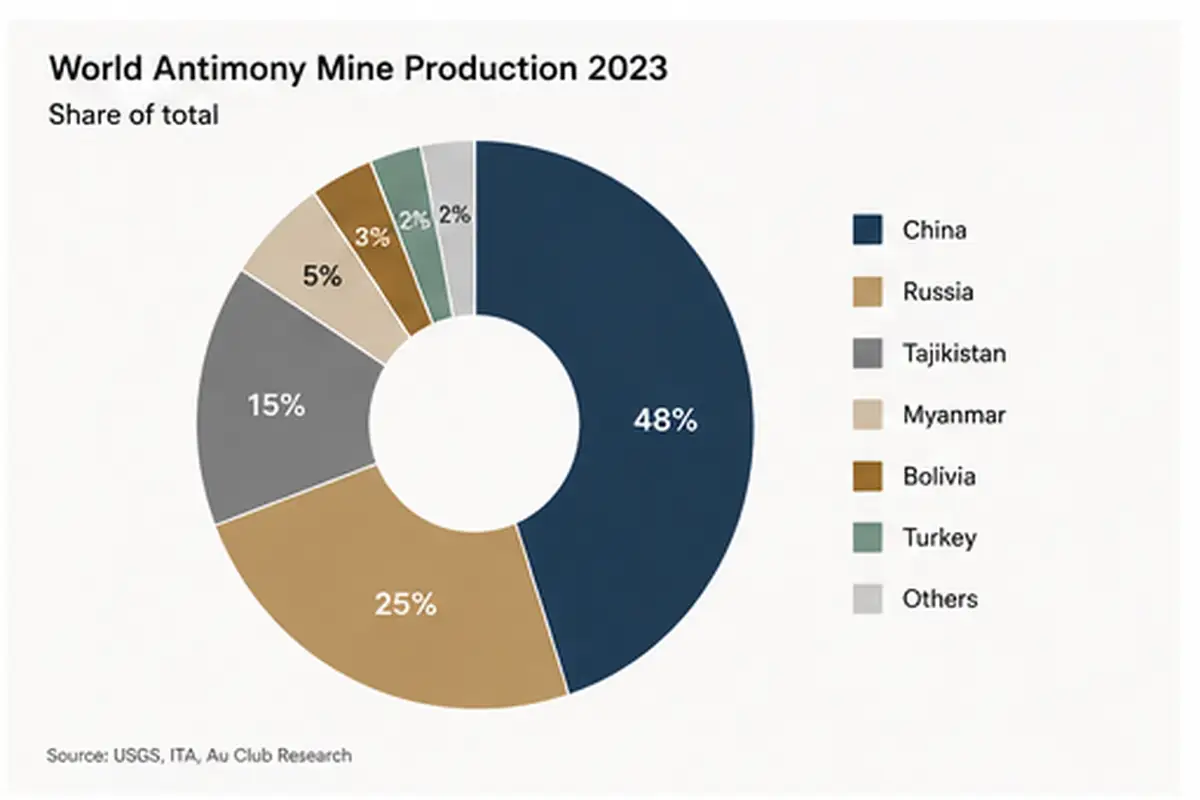
    Donut chart of world antimony mine production by country, China dominant at 48%

    Antimony is mined in fewer than fifteen countries at commercial scale. China accounts for roughly 48% of world mine production. Russia is next at around 25%. Tajikistan is third at approximately 15%. Bolivia, Myanmar, Turkey, Australia and a handful of others make up the balance.

    China’s dominance is amplified at the refining stage. Chinese smelters refine not only Chinese ore but also Russian, Burmese, and Tajik concentrate. The world’s tradeable antimony — antimony metal, antimony trioxide, antimony tri-sulphide — has moved through Chinese smelters even when the ore itself originated elsewhere.

    This is why the price went where it did. The market did not just lose 48% of supply. It lost the refining and trading infrastructure that aggregated the other 52%.

    Antimony price path, July–November 2024

    Month

    Price (USD/MT, FOB Asia)

    Move

    July 2024

    $1,400

    Base

    August 2024

    $22,000

    First licence rumour priced in

    Mid-September 2024

    $38,000

    Licence regime in force

    October 2024

    $44,500

    Stocks drawn

    November 2024

    $48,000

    Spot in Rotterdam

    By early 2025 the metal traded at $51,500 per metric ton. Fastmarkets has been assessing antimony prices since the 1980s. It has never seen this kind of move.

    Where antimony is consumed — and why substitution is harder than it sounds

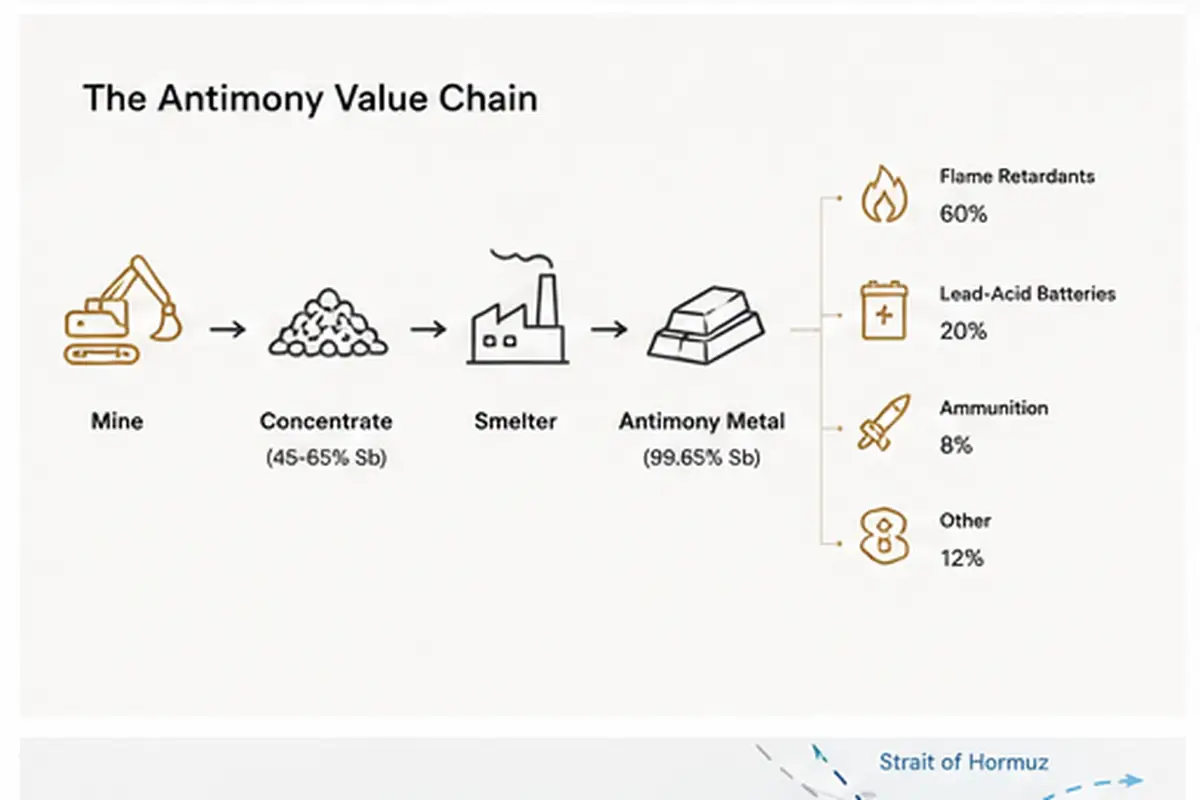
    Antimony value chain diagram from mine to end use

    Around 60% of refined antimony goes into flame retardants — chiefly antimony trioxide (Sb₂O₃) used in PVC, ABS, polyester resins, electronics housings, electrical cable jacketing, and textile back-coatings. Approximately 20% goes into lead-acid batteries, where antimony is alloyed with lead to harden battery plates. The remainder is split between ammunition primers, glass fining, catalysts, and a small but strategically important share in solar photovoltaic glass.

    Substitutes exist for some applications:

    • Flame retardants — phosphorus-based and halogen-free alternatives can substitute in some polymer systems, but reformulation requires UL recertification, supplier audits, and a six-to-twelve month qualification cycle.
    • Lead-acid batteries — calcium-alloyed plates already dominate the starter-battery market, but deep-cycle and stationary applications still rely on antimonial lead.
    • Ammunition — no commercially viable substitute exists for antimony in primer compositions and shot hardening.

    The result: industrial flame retardant buyers cannot meaningfully reduce their antimony exposure inside a twelve-month window. Battery manufacturers can only partially. The defence supply chain has no substitute path at all. That is why the December 2024 military-end-use prohibition matters — it forces Western defence procurement to find non-Chinese, non-Russian antimony at a moment when neither is reliably available.

    The non-China supply map

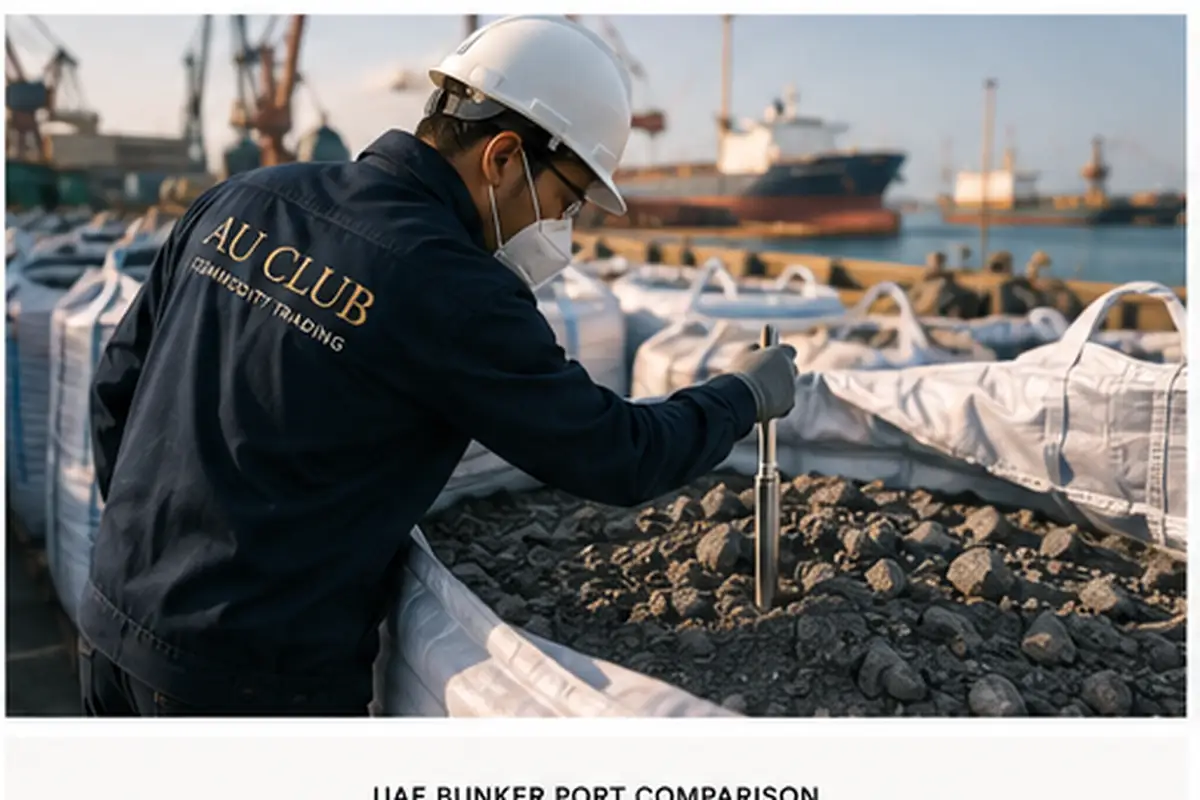
    Inspector sampling antimony concentrate at port warehouse

    Au Club’s working view of the non-China antimony supply universe in late 2024:

    • Tajikistan — the Anzob mine and Konimansur deposit. Output is captive to Russian-aligned offtakers in practice. Commercial availability for Western buyers is limited and the routing complexity is high.
    • Russia — Polyus and other producers. Sanctioned for direct sale into the US and UK markets after April 2024. Triangulation possible through third countries but creates origin documentation risk.
    • Bolivia — small-scale producers. Sb concentrate of 45-60% Sb is the working grade. Logistics through Arica, Chile or the Pacific via Iquique. Volumes are small relative to demand but the origin is clean.
    • Myanmar — informal mining and smelting. Significant volume historically flowed into Chinese refineries. Direct export to non-Chinese buyers exists but quality and documentation are inconsistent.
    • Turkey — small mine production. Domestic consumption absorbs most of it.
    • Australia — Hillgrove (NSW) restarted production planning. First commercial concentrate flow expected late 2025 / early 2026.

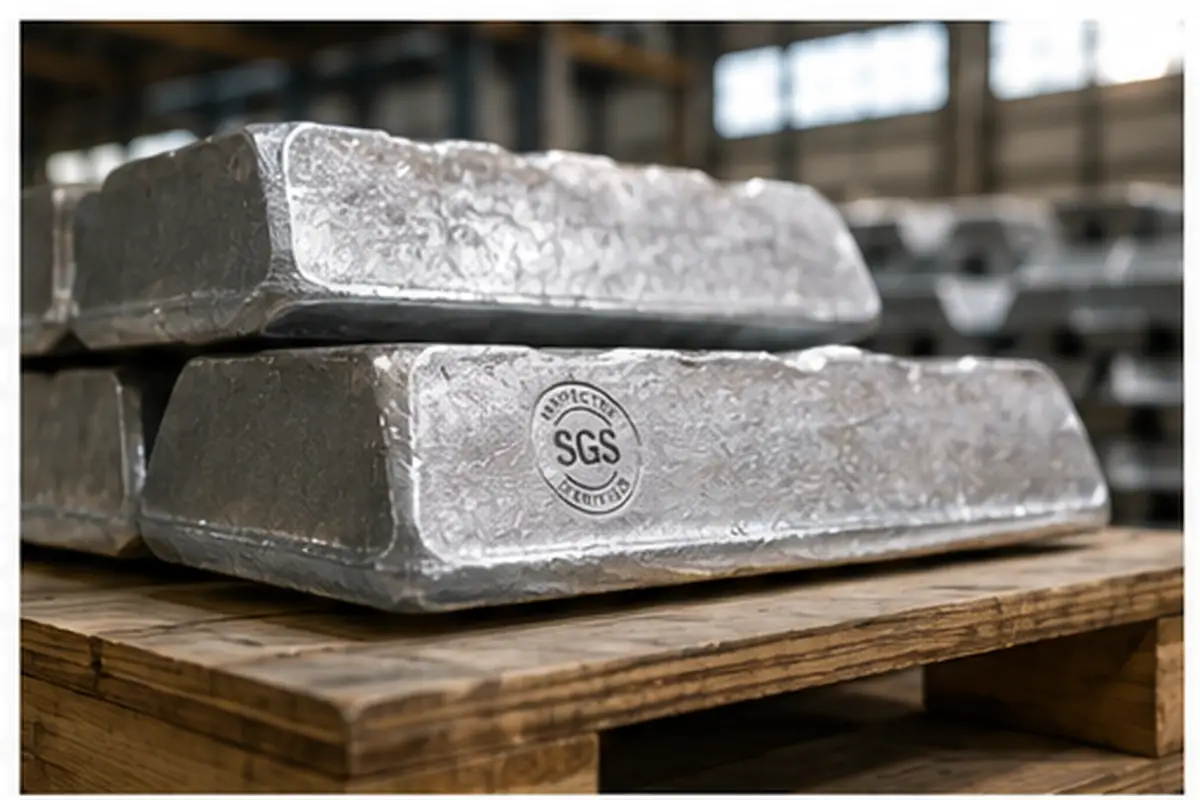
    Au Club’s offer covers antimony concentrate (45–65% Sb) and antimony ingots, with 100-300 MT/month availability through non-Chinese routes. We do not handle Russian-origin material.

    How to write a 2025 antimony contract

    If your existing contracts use Fastmarkets China Sb 99.65% as the benchmark, that benchmark may not have a meaningful market behind it for non-China material. Three contractual considerations matter more than they used to:

    1. Origin clause — explicit identification of the country of mining and country of smelting. “Non-Chinese, non-Russian origin” is the most common Western buyer requirement post-December 2024.
    2. Price formula — a floating reference against Fastmarkets Antimony Ingot 99.65% Rotterdam, with an explicit premium for confirmed origin, is now the dominant structure for non-China material.
    3. Force majeure — should explicitly include export licence withdrawal, host-country export quotas, and shipment delays caused by sanctions screening. Generic FM language drafted before August 2024 is not sufficient.

    Pre-shipment inspection should be by SGS, Alex Stewart, or Intertek with a Certificate of Analysis covering Sb, As, Pb, Bi and S content. The COA, the certificate of origin, and the bill of lading should travel as a single document set under any LC.

    Au Club’s read for 2025 and 2026

    The licence regime is not going to be quietly lifted. Antimony’s pricing in 2025 will be set by the cleared-licence flow from China — likely small, unpredictable, and bid-up by defence buyers — against rising non-China supply from Tajikistan, Bolivia, and eventually Hillgrove. Our working range for Fastmarkets Antimony Ingot 99.65% Rotterdam through 2025 is $42,000 to $58,000 per MT.

    What we are telling buyers: lock 12-month supply now, accept a higher annual average than 2023, and structure the contract so origin documentation moves with the cargo. For 2026, plan for a market that has structurally re-priced. There is no version of this story where antimony returns to $1,400.

    FAQs

    Is antimony still banned from China?

    Antimony is not banned. It is under a dual-use export licence regime introduced 15 September 2024. MOFCOM approves licences case by case. Export volumes since September 2024 have been a small fraction of historical levels. A specific prohibition exists, since 3 December 2024, on exports to US military end-users.

    What is the antimony price today?

    At time of writing in November 2024, Fastmarkets Antimony Ingot 99.65% Rotterdam was assessed around $48,000 per MT. For real-time pricing, contact our trading desk.

    Where else can I buy antimony concentrate?

    Tajikistan, Bolivia, Myanmar, Turkey, and (from late 2025) Australia. Au Club sources from non-Chinese, non-Russian origins and supplies 45-65% Sb concentrate plus ingots, 100-300 MT/month.

    About Au Club

    Au Club is a Dubai-based commodity trading company supplying marine fuel, metals, and minerals worldwide. We trade antimony concentrate and antimony ingots from non-Chinese origins, with SGS or Alex Stewart pre-shipment inspection and full documentation. To enquire about availability and pricing, contact our trading desk.

    Sources & further reading